
October 28, 2026 · 星期三
The Heart-Mind
心· heart

 Today’s episode with Jason and Amy
In Chinese philosophy, the heart and mind are seen as one, reflecting a holistic approach to understanding human nature.
霜降 is the last solar term of autumn, when the first frosts settle over the land and temperatures drop toward winter. White rime coats the morning fields, leaves blaze red and fall, and the harvest draws to a close.
People eat persimmons, said to ward off cold and chapped lips, and in some regions enjoy mutton to build warmth for winter.
The Heart-Mind
心xīn
The concept of 'xīn' (心) in Chinese philosophy is a profound one, as it embodies both the heart and the mind. This duality highlights how emotions and intellect are intertwined in traditional Chinese thought. The heart-mind is seen as the center of a person’s being, a place where feelings and thoughts converge to guide actions and decisions. This holistic approach to understanding human nature is evident in many classical texts, such as 'The Book of Changes' (《易经》), where the balance between heart and mind plays a crucial role in achieving harmony with the universe[1].
In the teachings of Confucius, the heart-mind is central to cultivating virtue and proper conduct. Confucius emphasized the importance of aligning one's heart and mind to achieve 'ren' (仁), which can be translated as humaneness or benevolence. By harmonizing emotions and thoughts, individuals can develop empathy and moral integrity, essential traits for contributing positively to society. This idea echoes through Confucian texts like 'The Analects' (《论语》), where the heart-mind is pivotal for self-cultivation and social harmony[2].
The integration of heart and mind also appears in traditional Chinese medicine, where emotional and mental health are seen as interconnected. Practices such as qigong and meditation focus on balancing the heart-mind to maintain overall well-being. By nurturing this balance, individuals can achieve a state of 'xinping' (心平), or a peaceful heart, which is believed to promote physical health and spiritual growth. Today, this concept influences wellness practices worldwide as people seek holistic approaches to health that address both emotional and intellectual aspects of their lives.
In Chinese philosophy, the heart and mind are seen as one, reflecting a holistic approach to understanding human nature.
心是感情与思想的中心。
Xīn shì gǎnqíng yǔ sīxiǎng de zhōngxīn.
The heart-mind is the center of emotions and thoughts.
- [1] 《易经》 The Book of Changes
- [2] 《论语》 The Analects by Confucius
Jason & Amy on 心
Podcast: Dragon Daily: The Heart-Mind — and the word 心
Jason & Amy on The Heart-Mind and 心
New here?
October 28, 2026
Today's history reflects key moments in architecture and contributions from notable cultural figures.

N509FZ / Wikimedia Commons (CC BY 4.0) sourcelicence Beijing Becomes Capital with Completion of Forbidden City 故宫
The construction of the Forbidden City in Beijing marked the official designation of the city as the capital of the Ming dynasty. This architectural marvel served as the imperial palace for 24 emperors.
The Forbidden City remains a symbol of China's rich imperial history and architectural achievement.
Read moreDeath of Historian Liang Congjie 梁从诫
Liang Congjie, a prominent Chinese historian and conservationist, was known for his role in founding Friends of Nature, China's first environmental NGO. His work played a significant part in raising environmental awareness in the country.
Liang's efforts laid the groundwork for environmental activism in China.
Read more
我爱妈妈的心。
Wǒ ài māmā de xīn.
I love my mother's heart.
The word '心' refers to the heart.
他的心很善良。
Tā de xīn hěn shànliáng.
His heart is kind.
Here, '心' conveys the concept of kindness and good nature.
心灵需要平静。
Xīnlíng xūyào píngjìng.
The soul needs tranquility.
The term '心灵' includes both heart and mind, emphasizing inner peace.
心的和谐是智慧的源泉。
Xīn de héxié shì zhìhuì de yuánquán.
Harmony of the heart is the source of wisdom.
In this context, '心' represents the heart-mind's role in gaining wisdom.
The use of '是' for identification
Subject + 是 + Noun
'是' is used to equate two nouns, identifying one as the other.
Use '是' to express identity or equivalence between two nouns.
她是老师。
Tā shì lǎoshī.
She is a teacher.
这是书。
Zhè shì shū.
This is a book.
我的爱好是音乐。
Wǒ de àihào shì yīnyuè.
My hobby is music.
What does 心 mean?
How is 心 pronounced?
How do you write "heart/mind" in Chinese?
Listen. What does the sentence mean?
他的___很善良。(His ___ is kind.)
他的心很善良。 — What does this sentence mean?
In Chinese philosophy, what does '心' represent?
Arrange into a correct sentence
Which architectural wonder was completed in 1420 in Beijing?
Who was Liang Congjie?
Frequently asked questions about the word 心
You can use 心 in sentences like '我心里很高兴' (Wǒ xīn lǐ hěn gāoxìng - I am very happy in my heart).
Yes, expressions like '心安理得' (xīn ān lǐ dé - to feel justified) incorporate this character.
心 refers more to emotions and intentions, while 思想 (sīxiǎng) pertains to thoughts and ideas.
Chinese Learner’s Horoscope
Your sign’s reading for today, written for learners.
Find your sign
The Chinese zodiac assigns each birth year one of twelve animals, each paired with an element that colours its character. Yours shapes a reading written for learners.
- Your sign and its elementOne of twelve animals on a 12-year cycle
- A daily affirmationFresh every morning, never repeated
- A learning horoscopeWhat to study today, and when
- A lucky characterWith pinyin, meaning and a study tip
Your birth date
Saved on this device — used only to work out your zodiac sign.
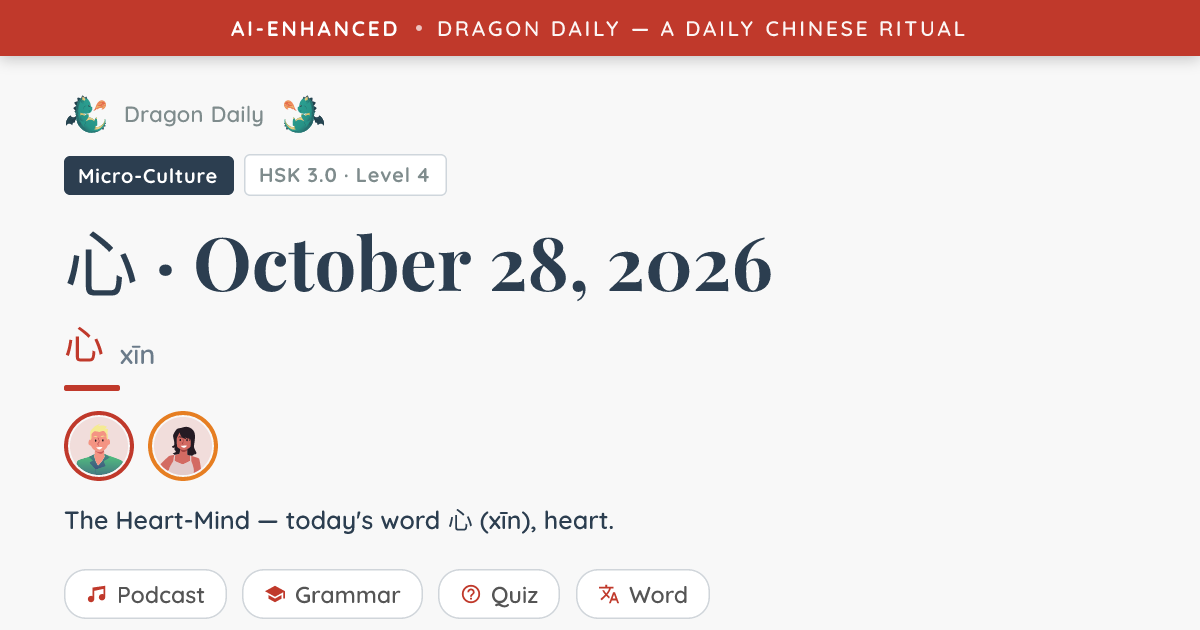
Today's Mandarin word: 心 (xīn) — heart.
Learn it on Mandarin Temple's Dragon Daily 🐉