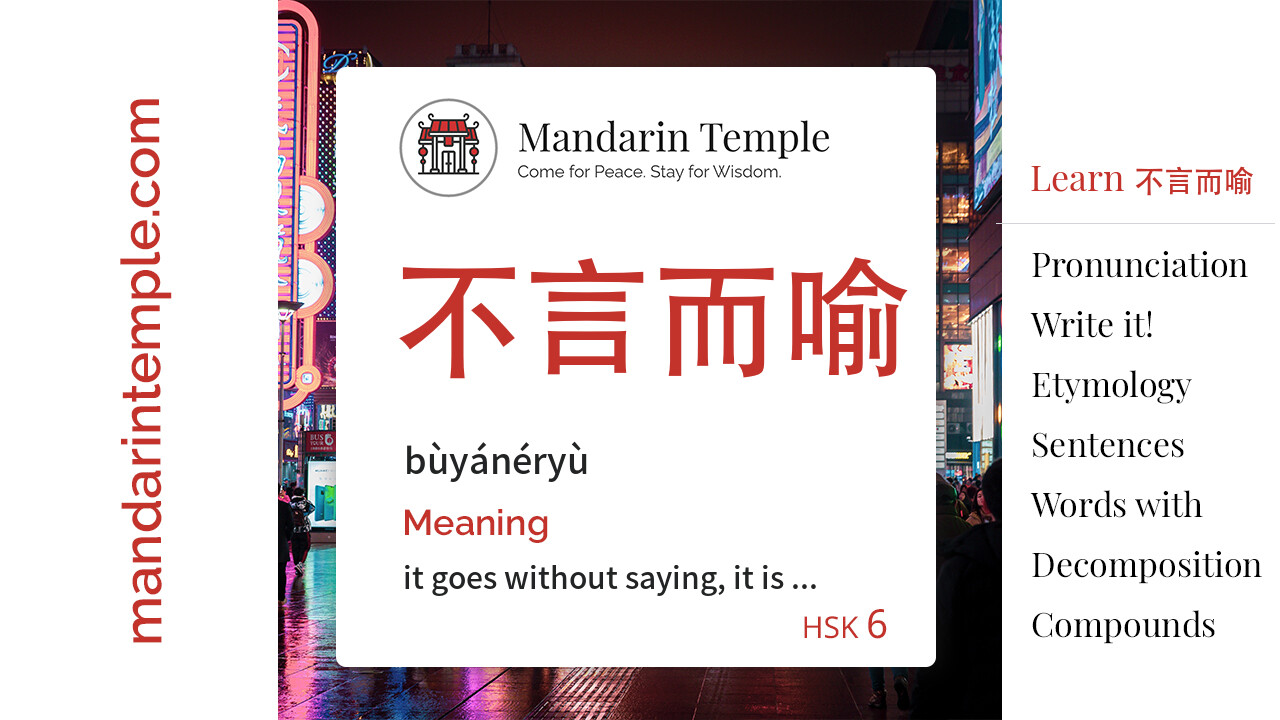
Featured image for 不言而喻 bùyánéryù Dictionary entry displaying the word's hanzi, pinyin and the Mandarin Temple logo and tagline.

不言而喻

不言而喻 bùyánéryù

不言而喻 bùyánéryù Meaning

Learn the Pinyin Pronunciation and 2 English Translations of the word 不言而喻 bùyánéryù .

Pīnyīn Pronunciation
bùyánéryù | bu4 yan2 er2 yu4
English translation
it goes without saying
it is self-evident

Learn the Chinese word 不言而喻 bùyánéryù in 7 easy steps:

About 不言而喻 bùyánéryù

Read some general information about the Chinese word 不言而喻 bùyánéryù .

Traditional form

不言而喻 bùyánéryù

Part of speech

Idiom / 成语 chéngyǔ Chéngyǔ
Spread the word

Mandarin Temple

Come for Peace. Stay for Wisdom.

Etymology of 不言而喻 bùyánéryù

Familiarize yourself with the origin and historical aspects of the Chinese word 不言而喻 bùyánéryù .

Type

ideographic

Explanation

Pictograph of sepals of a flower. The meaning "no" is a phonetic loan.

Positional decomposition

Number of Strokes

4

yán

Type

ideographic

Explanation

Pictograph of a tongue sticking out of a mouth. In old scripts written the same as shé but with an extra line.

Positional decomposition

tóu 二口

Number of Strokes

7

ér

Explanation

Originally a pictograph of a beard, now written as Ér . The current use as a conjunction is a phonetic loan.

Positional decomposition

Number of Strokes

6

Type

pictophonetic

Explanation

Phonosemantic compound. kǒu represents the meaning and represents the sound.

Phonetic compound

Semantic compound

kǒu

Positional decomposition

口俞

Number of Strokes

12

Write it!

Practice your Chinese writing skills and learn precisely where and when to draw every stroke of the
Chinese word 不言而喻 bùyánéryù .
     Press the Show Strokes button to see the strokes and their order and hit Start Drawing when you are
ready to practice.

Example sentences using 不言而喻 bùyánéryù

Broaden your vocabulary by interacting with 1 audio-assisted sentences using the Chinese word 不言而喻 bùyánéryù in different contexts.

rén 年纪 niánjì 越大通常 tōngcháng 灵活性 líng huó xìng 越差这是不言而喻 bùyánéryù de

It is axiomatic that as people grow older they generally become less agile.

Recommended Books for Learning Mandarin Chinese

AMAZON BOOKSHELF

AMAZON BOOKSHELF

A Boy and his Dragon

Once upon a time, a Little Boy was living in a village near the woods. One day, a Dragon came out of the cave secluded in the middle of the forest and began to relentlessly follow the Little Boy, always breathing on the back of his neck, burning the young boy at his slightest misstep.

The child received refuge in an old Temple where there were no mirrors allowed, and it was forbidden to speak of life before entering the sanctum. Ancient books, hidden rooms with unimaginable treasures and beauty beyond comprehension, became part of the boy’s new life.

Time went by until, one day, the now old young boy accidentally glimpses his own reflection in a pond. The Dragon smiled back.

Come for Knowledge. Stay for Wisdom.

Copyright © 2026 Mandarin Temple. All rights reserved.

Scroll to Top