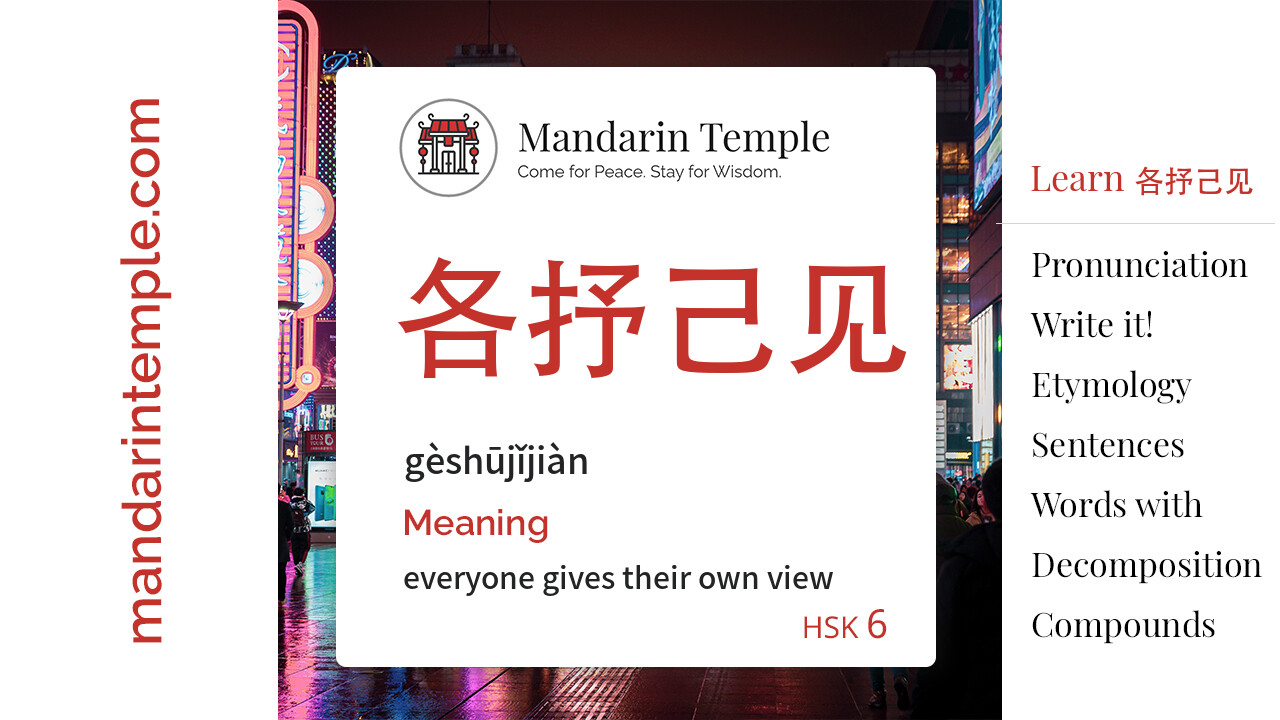
Featured image for 各抒己见 gèshūjǐjiàn Dictionary entry displaying the word's hanzi, pinyin and the Mandarin Temple logo and tagline.

各抒己见

各抒己见 gèshūjǐjiàn

各抒己见 gèshūjǐjiàn Meaning

Learn the Pinyin Pronunciation and 1 English Translations of the word 各抒己见 gèshūjǐjiàn .

Pīnyīn Pronunciation
gèshūjǐjiàn | ge4 shu1 ji3 jian4
English translation
everyone gives their own view

Learn the Chinese word 各抒己见 gèshūjǐjiàn in 6 easy steps:

About 各抒己见 gèshūjǐjiàn

Read some general information about the Chinese word 各抒己见 gèshūjǐjiàn .

Traditional form

各抒己見

Part of speech

Idiom / 成语 chéngyǔ Chéngyǔ
Spread the word

Mandarin Temple

Come for Peace. Stay for Wisdom.

Etymology of 各抒己见 gèshūjǐjiàn

Familiarize yourself with the origin and historical aspects of the Chinese word 各抒己见 gèshūjǐjiàn .

Type

ideographic

Explanation

Pictograph of a foot ( zhǐ ) entering an opening, ( kǒu ), the opposite of chū (exit). Based on the original meaning "enter", unrelated to the current meaning "each", which is a phonetic loan.

Positional decomposition

夂口

Number of Strokes

6

shū

Type

pictophonetic

Explanation

Phonosemantic compound. represents the meaning and shǒu represents the sound.

Phonetic compound

shǒu

Semantic compound

Positional decomposition

扌予

Number of Strokes

7

Type

pictographic

Explanation

Origin unclear.

Positional decomposition

⿱? gōu

Number of Strokes

3

jiàn

Type

ideographic

Explanation

Simplified form of jiàn . Pictograph of a person ( jié ) using their eye () to see ( jiàn ).

Positional decomposition

冂儿

Number of Strokes

4

Write it!

Practice your Chinese writing skills and learn precisely where and when to draw every stroke of the
Chinese word 各抒己见 gèshūjǐjiàn .
     Press the Show Strokes button to see the strokes and their order and hit Start Drawing when you are
ready to practice.

Recommended Books for Learning Mandarin Chinese

AMAZON BOOKSHELF

AMAZON BOOKSHELF

A Boy and his Dragon

Once upon a time, a Little Boy was living in a village near the woods. One day, a Dragon came out of the cave secluded in the middle of the forest and began to relentlessly follow the Little Boy, always breathing on the back of his neck, burning the young boy at his slightest misstep.

The child received refuge in an old Temple where there were no mirrors allowed, and it was forbidden to speak of life before entering the sanctum. Ancient books, hidden rooms with unimaginable treasures and beauty beyond comprehension, became part of the boy’s new life.

Time went by until, one day, the now old young boy accidentally glimpses his own reflection in a pond. The Dragon smiled back.

Come for Knowledge. Stay for Wisdom.

Copyright © 2026 Mandarin Temple. All rights reserved.

Scroll to Top