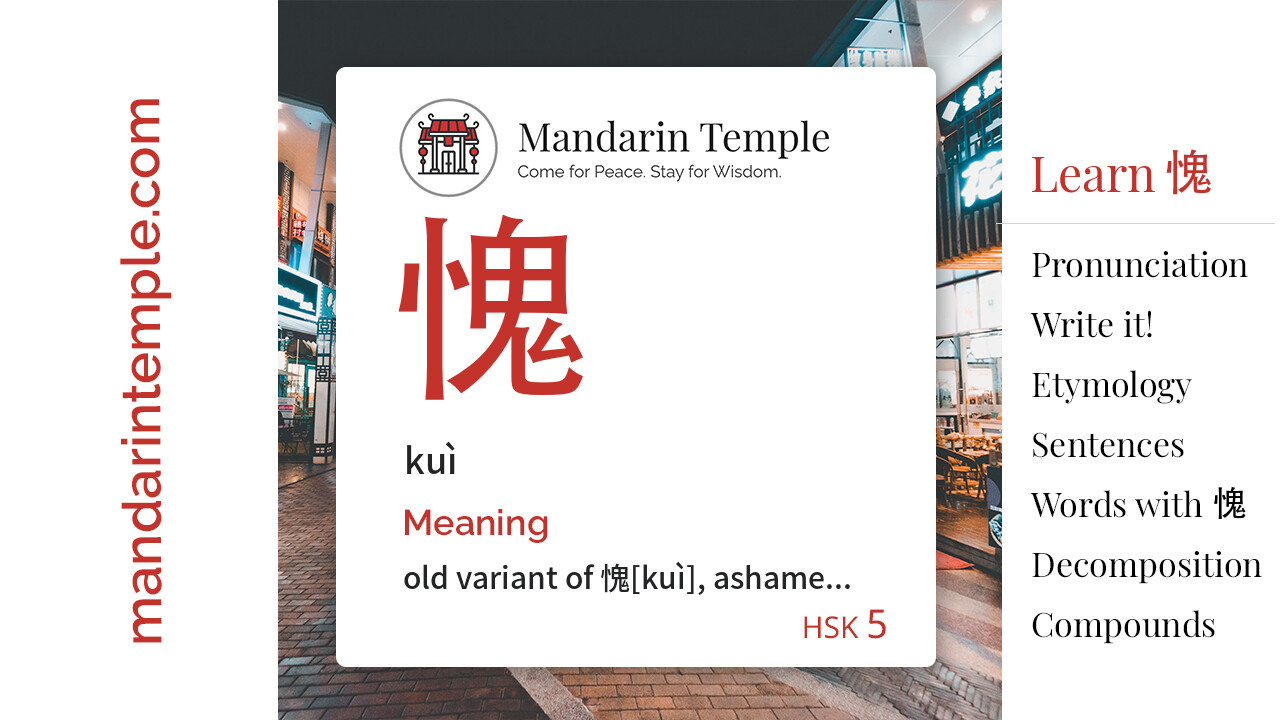
Featured image for 愧 kuì Dictionary entry displaying the word's hanzi, pinyin and the Mandarin Temple logo and tagline.

Pronunciation

kuì

To complete this step you need to listen to the audio pronunciation of the word once.

kuì Meaning

Learn the Pinyin Pronunciation and 4 English Translations of the word kuì .

To complete this step you need to read and scroll down.

Pīnyīn Pronunciation
kuì | kui4
English translation
old variant of kuì [kuì]
ashamed, regretful; the pangs of conscience

Learn the Chinese word kuì in 8 easy steps:

1
Start completing the learning steps to receive the bonus.
You have completed 4/7 steps. Keep going!
Congratulations! You have completed the first learning sequence for this character.
Temple Coins Received
0
2
Unlocks in 48h after completing the first learning phase.
Start completing the learning steps to receive the bonus.
You have completed 4/7 steps. Keep going!
Congratulations! You have completed the second learning sequence for this character.
Temple Coins Received
0
3
Unlocks in 7 days after completing the second learning phase.
Start completing the learning steps to receive the bonus.
You have completed 4/7 steps. Keep going!
Congratulations! You have completed the second learning sequence for this character.
Temple Coins Received
0
Slide 1 Heading
Lorem ipsum dolor sit amet consectetur adipiscing elit dolor
Click Here
Slide 2 Heading
Lorem ipsum dolor sit amet consectetur adipiscing elit dolor
Click Here
Slide 3 Heading
Lorem ipsum dolor sit amet consectetur adipiscing elit dolor
Click Here
Previous slide
Next slide

About kuì

Read some general information about the Chinese word kuì .

To complete this step you need to read and scroll down..

Number of strokes

12

Traditional form

媿

Contains the radical

xīn

Part of speech

Verb-like morpheme / 动词性语素 Dòngcí xìng yǔsù

Learning hint

heart

Etymology of kuì

Familiarize yourself with the origin and historical aspects of the Chinese word kuì .

To complete this step you need to read and scroll down..

Type

pictophonetic

Positional decomposition

忄鬼

Semantic compound

xīn

Phonetic compound

guǐ

Explanation

Phonosemantic compound. xīn represents the meaning and guǐ represents the sound. Simplified form of 媿.

Write it!

Practice your Chinese writing skills and learn precisely where and when to draw every stroke of the
Chinese word kuì .
     Press the Show Strokes button to see the strokes and their order and hit Start Drawing when you are
ready to practice.

To complete this step you need to write the word once.

Spread the word

Example sentences using kuì

Broaden your vocabulary by interacting with 5 audio-assisted sentences using the Chinese word kuì in different contexts.

To complete this step you need to listen to each of the five Chinese sentences at least once. and scroll down.

一方面 yī fāng miàn Dōng wéi 车上 de 乘客 chéng kè 感到 gǎn dào 惭愧 cánkuì .

On one hand, Tony was ashamed of the people on the train.

鸿 hóng jiān dào : Dǒng 先生 Xiānsheng 不愧 bùkuì chū 名门 míng mén !

Hung - chien said, " Mr. Tung does indeed come from an illustrious family!

jiǔ xǐng 之后 zhī hòu , huì 为你 de 所作所为 suǒ zuò suǒ wéi ér 感到 gǎn dào 羞愧 xiū kuì .

When you sober up, you'll be ashamed of what you've done.

当然 dāngrán ,常常 cháng cháng Xiàng rén jiè Qián 自己 zìjǐ huì 惭愧 cánkuì de .

Of course he would be ashamed to borrow often.

厚赐 shòu zhī 有愧.

I feel unworthy of the precious gift you have bestowed on me.

Words with kuì

Explore 20 words and sayings that include the Chinese character kuì in their composition.

To complete this step you need to read and scroll down.

FrequencySimplifiedMeaningTraditional
羞愧 xiū kuì ashamed羞愧 xiū kuì
不愧 bùkuì to be worthy of不愧 bùkuì
愧疚 kuì jiù to feel guilty愧疚 kuì jiù
惭愧 cánkuì ashamed慚愧
当之无愧 dāng zhī wú kuì fully deserving, without any reservations (idiom); entirely worthy (of a title, honor etc)當之無愧
kuì old variant of kuì [kuì]媿
无愧 wú kuì to feel no qualms無愧
问心无愧 wèn xīn wú kuì lit. look into one's heart, no shame (idiom); with a clear conscience問心無愧
自愧不如 zì kuì bù rú ashamed of being inferior (idiom)自愧不如 zì kuì bù rú
愧对 kuì duì to be ashamed to face (sb)愧對
愧色 kuì sè ashamed look愧色 kuì sè
愧不敢当 kuì bù gǎn dāng You flatter me too much.愧不敢當
抱愧 bào kuì feel ashamed抱愧 bào kuì
自愧弗如 zì kuì fú rú to feel ashamed at being inferior (idiom)自愧弗如 zì kuì fú rú
感愧 gǎn kuì to feel gratitude mixed with shame感愧 gǎn kuì
愧恨 kuì hèn ashamed and sorry愧恨 kuì hèn
俯仰无愧 fǔ yǎng wú kuì to have a clear conscience俯仰無愧
愧赧 kuì nǎn red-faced愧赧 kuì nǎn
扪心无愧 mén xīn wú kuì lit. look into one's heart, no shame (idiom); with a clear conscience捫心無愧
不愧不怍 bù kuì bù zuò upright and above board不愧不怍 bù kuì bù zuò

kuì Decomposition & Compounds

To complete this step you need to read and scroll down.

kuì Decomposition

See the 5 Chinese characters that make up kuì and their own compounds.

Recommended Books for Learning Mandarin Chinese

AMAZON BOOKSHELF

AMAZON BOOKSHELF

A Boy and his Dragon

Once upon a time, a Little Boy was living in a village near the woods. One day, a Dragon came out of the cave secluded in the middle of the forest and began to relentlessly follow the Little Boy, always breathing on the back of his neck, burning the young boy at his slightest misstep.

The child received refuge in an old Temple where there were no mirrors allowed, and it was forbidden to speak of life before entering the sanctum. Ancient books, hidden rooms with unimaginable treasures and beauty beyond comprehension, became part of the boy’s new life.

Time went by until, one day, the now old young boy accidentally glimpses his own reflection in a pond. The Dragon smiled back.

Come for Knowledge. Stay for Wisdom.

Copyright © 2026 Mandarin Temple. All rights reserved.

Scroll to Top