

October 13, 2026 · 星期二
Riverside Reeds
芦苇· rushes, reeds

 Today’s episode with Jason & Amy
Reeds in Chinese culture symbolize both natural beauty and emotional depth.
寒露 marks the point when the dew turns cold and may verge on frost, signaling a sharper, deeper autumn chill. The air grows dry and brisk, migrating birds head south, and chrysanthemums come into bloom.
People climb heights to admire the autumn views, enjoy chrysanthemums, and in some places drink chrysanthemum wine for health.
Riverside Reeds
芦苇lú wěi
In the ancient text known as the Book of Songs, one of the earliest Chinese poetry collections, the imagery of reeds (芦苇, lúwěi) by a riverside is prominently featured. This natural setting evokes feelings of longing and nostalgia, resonating with readers through the ages[1]. The delicate rustling of the reeds symbolizes the gentle passage of time and the wistful thoughts of those who observe them. The use of nature to express human emotion is a hallmark of Chinese literature, and the reeds serve as a powerful metaphor for feelings that are both fleeting and enduring.
Reeds, or 芦, have been a significant part of Chinese culture beyond poetry. They are often found in traditional Chinese paintings, where their graceful forms are captured in ink. These paintings emphasize the harmonious relationship between humans and the natural world, a theme deeply ingrained in Chinese philosophy. The visual representation of reeds in art carries a sense of tranquility and balance, reflecting the principles of harmony and simplicity valued in Chinese aesthetics.
In addition to their symbolic meaning, reeds are also practical and widely used in various aspects of daily life. They are employed in making mats, baskets, and even musical instruments like the traditional Chinese flute, known as the dizi. The versatility of reeds highlights the ingenious ways in which natural materials have been utilized throughout Chinese history, showcasing human creativity and adaptability.
Today, as we reflect on the significance of reeds in Chinese culture on the 4th day of the 9th lunar month, we are reminded of their enduring presence in art and life. Reeds continue to inspire artists and writers, serving as a bridge between the past and the present, and between nature and human emotion.
Reeds in Chinese culture symbolize both natural beauty and emotional depth.
芦苇在河边摇曳。
Lúwěi zài hé biān yáoyè.
Reeds sway by the riverside.
- [1] The Book of Songs (《诗经》), an ancient Chinese poetry collection
Jason & Amy on 芦
Podcast: Dragon Daily: Riverside Reeds — and the word 芦
Jason & Amy on Riverside Reeds and 芦
New here?
October 13, 2026
Today marks contributions in Chinese literature and space exploration as well as the birth of an influential emperor.
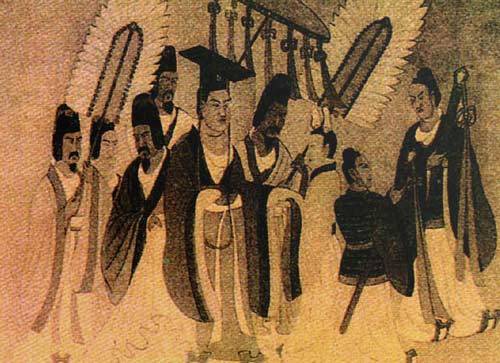
Original uploader was Jason22 at zh.wikipedia / Wikimedia Commons (Public domain) source Birth of Emperor Xiaowen of Northern Wei 北魏孝文帝
Emperor Xiaowen was a significant ruler of the Northern Wei dynasty, implementing major reforms in administration and culture. He promoted the Sinicization of the state, blending Chinese traditions with those of his own Tuoba clan.
His policies laid important foundations for future developments in Chinese history.
Read moreBirth of Walasse Ting, Chinese-American Painter 丁雄泉
Walasse Ting was a prolific Chinese-American painter and poet, known for his vibrant and colorful works. He published numerous works combining poetry and visual art, gaining prominence in the international art scene.
His art continues to inspire with its blend of Eastern and Western influences.
Read more
中国新闻网 / Wikimedia Commons (CC BY 4.0) sourcelicence Birth of Nie Haisheng, Chinese Astronaut
Nie Haisheng is a celebrated Chinese astronaut known for his contributions to China's manned space programs. He has participated in multiple significant space missions, including missions aboard Shenzhou 6 and Shenzhou 10.
Nie Haisheng's achievements highlight China's advances in space exploration.
Read more
这是芦。
Zhè shì lú.
This is a reed.
A simple sentence identifying a reed.
芦在水边生长。
Lú zài shuǐ biān shēngzhǎng.
Reeds grow by the water.
Describes the natural habitat of reeds.
芦苇象征着思念。
Lúwěi xiàngzhēng zhe sīniàn.
Reeds symbolize longing.
Explains the symbolic meaning of reeds.
芦苇的摇曳让人心生感慨。
Lúwěi de yáoyè ràng rén xīnshēng gǎnkǎi.
The swaying of reeds evokes deep feelings.
A nuanced expression of how reeds affect emotions.
在 + place + action
在 + place + action
This structure is used to indicate where an action takes place.
Use it to specify the location of an action.
我在家看书。
Wǒ zài jiā kàn shū.
I read books at home.
他在学校学习。
Tā zài xuéxiào xuéxí.
He studies at school.
我们在公园散步。
Wǒmen zài gōngyuán sànbù.
We walk in the park.
What does 芦 mean?
How is 芦 pronounced?
How do you write "reed" in Chinese?
Listen. What does the sentence mean?
___苇在水边。(Reeds are by the water.)
芦苇在河边摇曳 — What does this sentence mean?
What is a symbolic meaning of reeds in Chinese culture?
Arrange into a correct sentence
Which Chinese astronaut was born today in 1996?
Who was Walasse Ting?
Frequently asked questions about the word 芦
You might encounter phrases like '芦苇荡' (lúwěidàng), meaning 'reed marsh', which highlight its natural habitat.
Yes, while not commonly used in idiomatic expressions, it can appear in poetic contexts relating to nature.
芦 is pronounced 'lú' with a rising tone. Make sure to practice the tone to differentiate it from other similar sounds.
Chinese Learner’s Horoscope
Your sign’s reading for today, written for learners.
Find your sign
The Chinese zodiac assigns each birth year one of twelve animals, each paired with an element that colours its character. Yours shapes a reading written for learners.
- Your sign and its elementOne of twelve animals on a 12-year cycle
- A daily affirmationFresh every morning, never repeated
- A learning horoscopeWhat to study today, and when
- A lucky characterWith pinyin, meaning and a study tip
Your birth date
Saved on this device — used only to work out your zodiac sign.
Today's Mandarin word: 芦 (lú) — rushes, reeds.
Learn it on Mandarin Temple's Dragon Daily 🐉