
Podcast


Podcast: Tuina and Chinese Therapeutic Massage
Listen to Jason & Amy discuss Tuina and Chinese Therapeutic Massage
New here?
Origins of Therapeutic Touch
The practice of therapeutic massage in China has roots extending deep into antiquity. The earliest references to massage-like healing techniques appear in oracle bone inscriptions from the Shang dynasty, where shamanic healers are described as pressing and rubbing affected areas of the body. The Huangdi Neijing, compiled between the second century BCE and the second century CE, contains explicit discussions of massage techniques, referring to them as anmo (pressing and rubbing) and recommending their application for conditions ranging from paralysis to digestive disorders (Lo, 2002).
During the Han dynasty, massage therapy became increasingly formalized as a medical discipline. The Yinshu (Book of Pulling), discovered in a tomb at Zhangjiashan dating to approximately 186 BCE, contains detailed descriptions of therapeutic stretching and massage exercises for a wide range of ailments. These texts demonstrate that by the early imperial period, Chinese physicians had already developed a substantial body of empirical knowledge about the therapeutic effects of manual manipulation on the body (Harper, 1998).
The transition from anmo to tuina as the primary term for therapeutic massage occurred gradually during the Ming dynasty, reflecting a shift in emphasis from purely passive pressing and rubbing techniques to a broader repertoire that included pushing (tui) and grasping (na) maneuvers. However, the theoretical and practical foundations were laid during the imperial systematization period, when massage was integrated with the meridian theory and organ-system correspondences that had become central to Chinese medical thought (Pritchard, 2010).
"One push, one grasp — illness departs like silk being drawn from a cocoon."
Traditional tuina sayingSui and Tang Institutionalization
The Sui dynasty (581–618 CE) marked a turning point in the institutional recognition of massage therapy. The Zhubing Yuanhou Lun (Treatise on the Origins and Symptoms of Disease), compiled by Chao Yuanfang in 610 CE, included over two hundred self-massage and therapeutic exercise prescriptions alongside its nosological classifications. This integration of manual therapy into a comprehensive disease taxonomy demonstrated the medical establishment's acceptance of massage as a legitimate therapeutic modality with specific clinical indications (Unschuld, 2003).
Under the Tang dynasty (618–907 CE), massage therapy achieved its highest institutional status in premodern China. The imperial medical academy, the Taiyishu, established a dedicated department of massage (anmo ke) alongside departments of medicine, acupuncture, and incantation. This department employed massage doctors (anmo shi), massage practitioners (anmo gong), and massage students, with a formal curriculum and examination system. The Waitai Miyao (Arcane Essentials from the Imperial Library), compiled by Wang Tao in 752 CE, preserved numerous massage prescriptions from earlier sources that might otherwise have been lost (Lo, 2002).
The Tang-era systematization also produced important theoretical advances. Physicians of this period elaborated the relationship between massage techniques and the flow of qi through the meridian system, developing specific manipulations intended to tonify deficiency, drain excess, warm cold conditions, and cool heat patterns. These correspondences between manual techniques and the fundamental diagnostic categories of Chinese medicine gave tuina a theoretical sophistication that distinguished it from simple empirical bodywork and anchored it firmly within the broader medical tradition (Pritchard, 2010).
Techniques and Meridian Theory
Classical tuina encompasses a repertoire of approximately thirty fundamental hand techniques, each with specific therapeutic indications based on its effects on qi flow through the meridian system. The major categories include tui (pushing), na (grasping), an (pressing), mo (rubbing), rou (kneading), gun (rolling), dou (shaking), and ban (pulling or rotating). Each technique is defined by the practitioner's hand position, the direction and quality of force application, the speed and rhythm of movement, and the specific anatomical structures targeted (Pritchard, 2010).
The integration of tuina with meridian theory distinguishes it fundamentally from Western massage traditions. A tuina practitioner selects techniques and treatment points based on the same diagnostic framework used in acupuncture: the identification of pathological patterns involving specific organ systems, qi dynamics, and meridian pathways. Treatment follows the same principles of point selection and combination that guide acupuncture practice, with manual stimulation substituting for needle insertion. Many tuina protocols target the same acupoints used in acupuncture, applying sustained pressure, rhythmic compression, or rotational force to achieve therapeutic effects analogous to needling (Lo, 2002).
Beyond acupoint stimulation, tuina incorporates techniques directed at broader anatomical structures including muscles, tendons, joints, and fascial planes. Joint mobilization techniques, passive range-of-motion exercises, and traction maneuvers address musculoskeletal conditions, while abdominal massage protocols (fu an) target digestive and gynecological disorders through manipulation of the internal organs. This dual focus on meridian-based point therapy and structural bodywork gives tuina a therapeutic range that spans both the internal medicine and orthopedic domains of Chinese medical practice (Unschuld, 2003).
"Where there is free flow, there is no pain; where there is pain, there is no free flow."
Huangdi NeijingPediatric Tuina
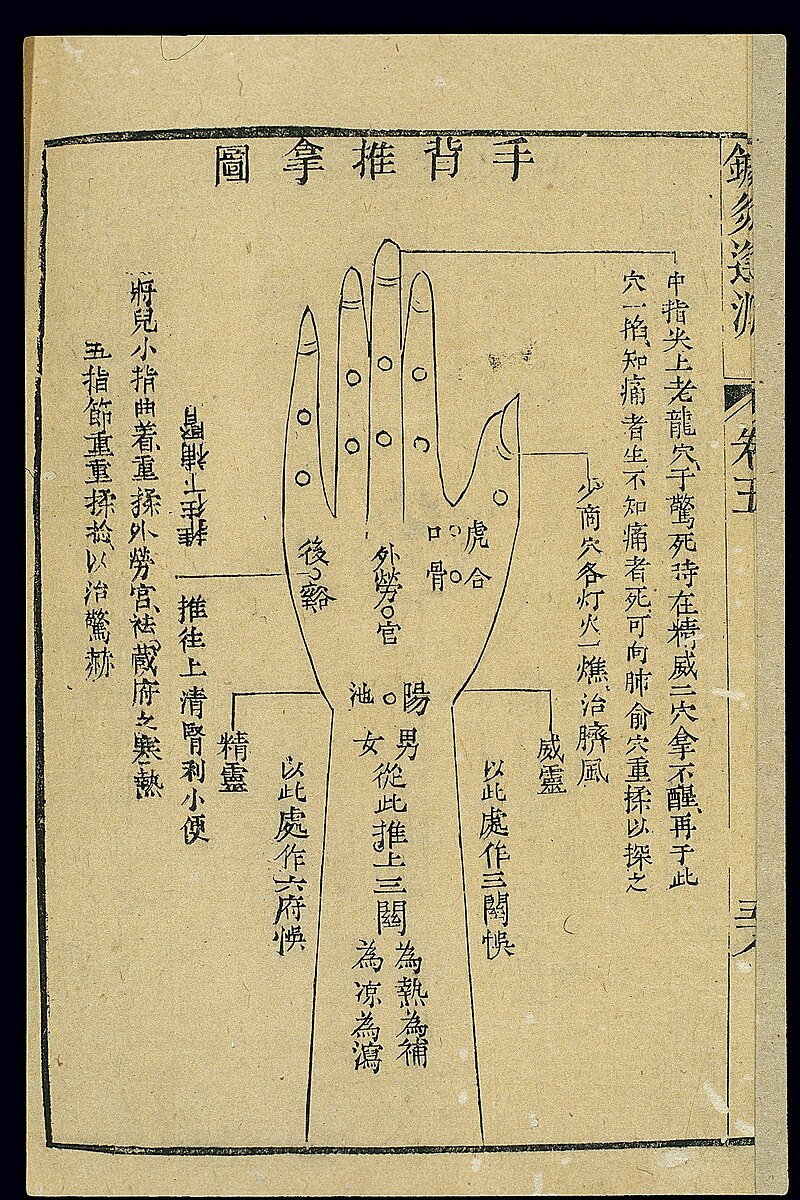
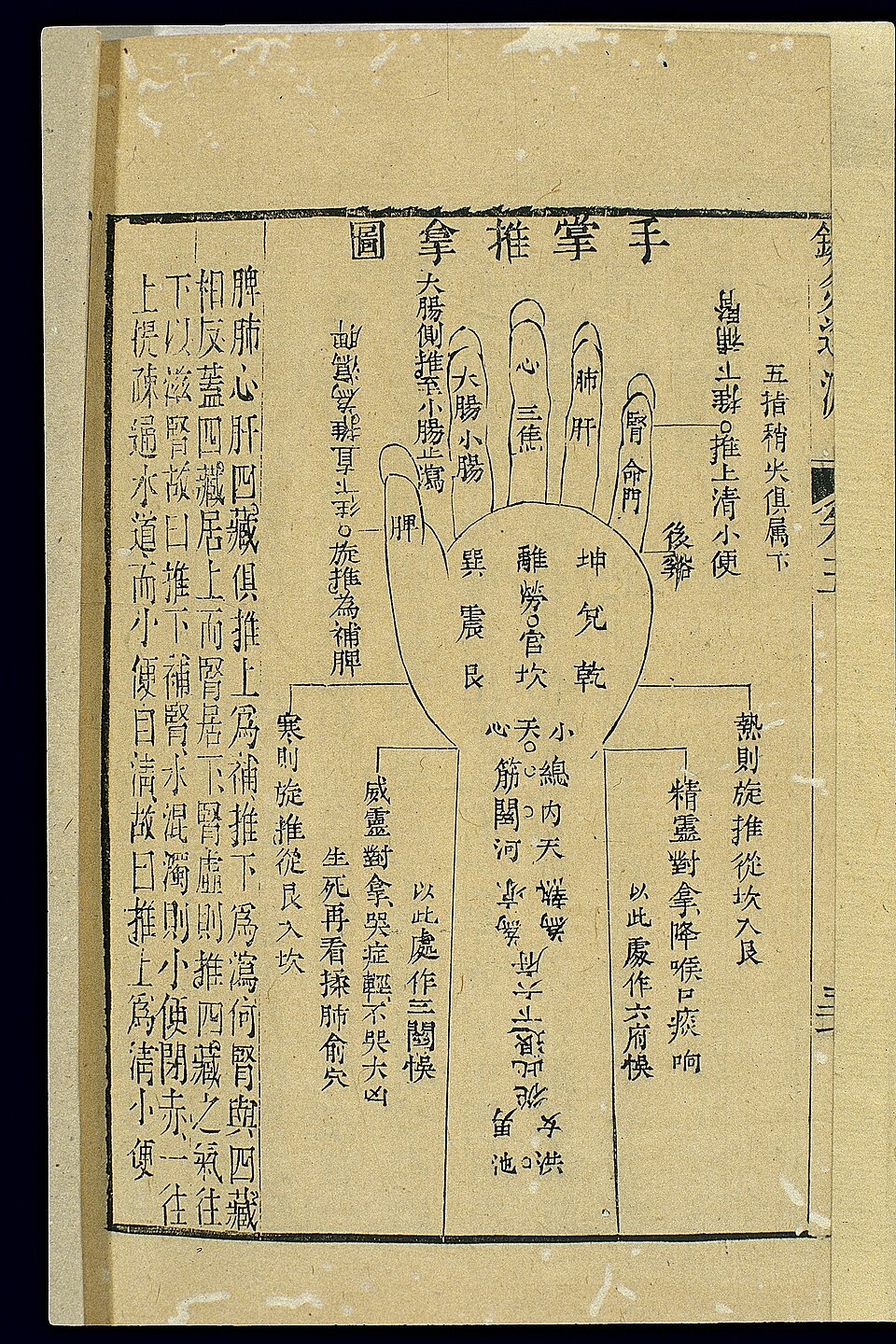
One of the most distinctive developments in the tuina tradition is the emergence of pediatric tuina (xiao'er tuina) as a specialized clinical discipline. Pediatric tuina employs a unique system of treatment points and techniques developed specifically for infants and young children, many of which have no direct correspondence to the acupoints used in adult practice. These pediatric-specific points are located primarily on the hands and forearms, with linear rather than punctate treatment areas that are stimulated through directional pushing techniques (Flaws, 2006).
The systematic codification of pediatric tuina is generally attributed to the Ming dynasty, with the publication of texts such as the Xiao'er Anmo Jing (Classic of Pediatric Massage) and the Xiao'er Tuina Guangyi (Extended Meaning of Pediatric Tuina). However, the roots of the tradition extend back to the Tang dynasty, when Chao Yuanfang's treatise included massage prescriptions specifically indicated for childhood illnesses. The development of a separate pediatric system reflected both practical considerations — young children cannot tolerate acupuncture needling well — and theoretical ones, as Chinese medical thinking recognized that children's immature organ systems required different therapeutic approaches (Pritchard, 2010).
Modern clinical research has investigated pediatric tuina for conditions including infantile diarrhea, colic, fever, cough, asthma, and failure to thrive. Several randomized controlled trials conducted in Chinese hospitals have reported positive outcomes, particularly for functional gastrointestinal disorders in infants. While methodological limitations have been noted by systematic reviewers, the accumulating evidence has supported the continued integration of pediatric tuina into clinical practice at major traditional Chinese medicine hospitals, where it is often used as a first-line treatment for common childhood complaints before resorting to herbal medicine or Western pharmaceuticals (Lee et al., 2012).
Clinical Applications and Research
Contemporary clinical practice of tuina spans a wide range of conditions, with the strongest evidence base in musculoskeletal medicine. Cervical spondylosis, lumbar disc herniation, frozen shoulder, and chronic low back pain are among the most common conditions treated with tuina in Chinese hospitals. A large body of clinical trial data, predominantly from Chinese institutions, reports favorable outcomes for these conditions, often comparing tuina favorably with pharmaceutical interventions or physiotherapy. The Chinese government's National Standard for Tuina Clinical Practice, published in 2008, codified treatment protocols for over sixty clinical conditions (Pritchard, 2010).
Beyond musculoskeletal medicine, tuina is applied clinically for internal medicine conditions including insomnia, chronic fatigue, headache, hypertension, and functional gastrointestinal disorders. The theoretical basis for treating internal conditions through surface manipulation rests on the meridian system's posited connections between the body surface and the internal organs. While the mechanisms remain debated, neurophysiological research has identified plausible pathways including the activation of mechanoreceptors, modulation of autonomic nervous system activity, and the release of endogenous opioids and anti-inflammatory mediators (Lee et al., 2012).
The integration of tuina with other therapeutic modalities is a hallmark of contemporary practice. In Chinese medical institutions, tuina is frequently combined with acupuncture, herbal medicine, cupping therapy, and moxibustion within comprehensive treatment plans. This multimodal approach reflects the traditional Chinese medical principle of treating complex conditions through complementary interventions that address different aspects of the pathological pattern. Research into the additive or synergistic effects of combined therapies represents an active area of clinical investigation (Lo, 2002).
"The hand follows the intention of the mind; the technique issues from the hand."
Yizong Jinjian (Golden Mirror of Medicine)Global Transmission and Future Directions
Tuina has spread internationally alongside acupuncture and herbal medicine, though it remains less widely known in Western countries than its companion modalities. Professional tuina training programs have been established in Europe, North America, and Australia, typically as components of broader traditional Chinese medicine curricula. In China, tuina practitioners undergo five years of university-level education that includes extensive training in Western anatomy, physiology, and clinical medicine alongside traditional theory and techniques (Pritchard, 2010).
The relationship between tuina and other manual therapy traditions has become a subject of increasing scholarly interest. Comparative studies have noted both parallels and significant differences between tuina and Western manual therapies such as Swedish massage, osteopathy, and chiropractic. While all these traditions share an emphasis on manual manipulation of the body's musculoskeletal structures, they differ fundamentally in their theoretical frameworks, diagnostic methods, and treatment principles. Tuina's integration with meridian theory and the broader conceptual apparatus of Chinese medicine gives it a distinctive clinical logic that cannot be reduced to biomechanical terms alone (Unschuld, 2003).
Future development of tuina as a clinical discipline will likely depend on the quality of research evidence supporting its efficacy. International interest in evidence-based manual therapies has created opportunities for rigorous clinical trials, though significant methodological challenges remain, including the difficulty of blinding and the standardization of complex manual interventions. The establishment of international research collaborations and the development of validated outcome measures for tuina-specific clinical effects represent important steps toward integrating this ancient therapeutic art into the global evidence-based healthcare framework (Lee et al., 2012).
Quiz
What was the primary term for therapeutic massage before the Ming dynasty?
Which dynasty marked a turning point in the institutional recognition of massage therapy?
What distinguishes tuina from Western massage traditions?
Which text contains detailed descriptions of therapeutic stretching and massage exercises from the Han dynasty?
What was a significant outcome of the Tang-era systematization of massage therapy?
What type of disorders is pediatric tuina particularly used for?
What is a hallmark of contemporary tuina practice?
What is a challenge in conducting rigorous clinical trials for tuina?
Write your thoughts, then get feedback from Jason — you can turn any answer into a full discussion.
9. How might the integration of tuina with meridian theory influence its effectiveness compared to other forms of manual therapy?
10. In what ways could the global transmission of tuina impact its practice and perception in Western countries?
Frequently Asked Questions
Common questions about Tuina and Chinese Therapeutic Massage
What is Tuina massage and how does it differ from Western massage?
Tuina is a form of Chinese therapeutic massage that uses rhythmic pressing, kneading, rolling, and stretching techniques along the body's meridian channels to regulate qi flow and treat musculoskeletal and internal conditions. Unlike Western massage which primarily targets muscles and soft tissue for relaxation, Tuina is rooted in traditional Chinese medical theory and aims to restore energetic balance across organ systems.
What conditions can Tuina treat?
Tuina is commonly used to treat musculoskeletal pain, headaches, digestive disorders, insomnia, and stress-related conditions. It is particularly effective for neck and back pain, joint stiffness, and sports injuries, and in Chinese hospitals it is often prescribed alongside acupuncture and herbal medicine as part of integrated treatment plans.
How old is the practice of Tuina?
Tuina is one of the oldest forms of therapeutic bodywork, with references to massage techniques appearing in oracle bone inscriptions from the Shang dynasty (c. 1600–1046 BCE). The Huangdi Neijing from around 300 BCE describes specific massage methods for treating various ailments, and Tuina has been practiced continuously in China for over three thousand years.
What techniques are used in Tuina massage?
Tuina practitioners employ over thirty distinct hand techniques including gun fa (rolling), tui fa (pushing), na fa (grasping), an fa (pressing), and mo fa (circular rubbing). These techniques vary in pressure and speed depending on the condition being treated, with vigorous methods used for acute musculoskeletal issues and gentler approaches for internal medicine and pediatric conditions.
Is Tuina safe for children and elderly patients?
Tuina has a well-established tradition of pediatric application (xiao er tuina) using gentle, specialized techniques adapted for infants and children to treat common complaints like colic, fever, and digestive issues. For elderly patients, practitioners adjust pressure and technique intensity, making Tuina a versatile therapy suitable for a wide range of ages and constitutions.