
Podcast


Podcast: The Forbidden City: Palace of Emperors
Listen to Jason & Amy discuss The Forbidden City: Palace of Emperors
New here?
A Palace for Ten Thousand Years
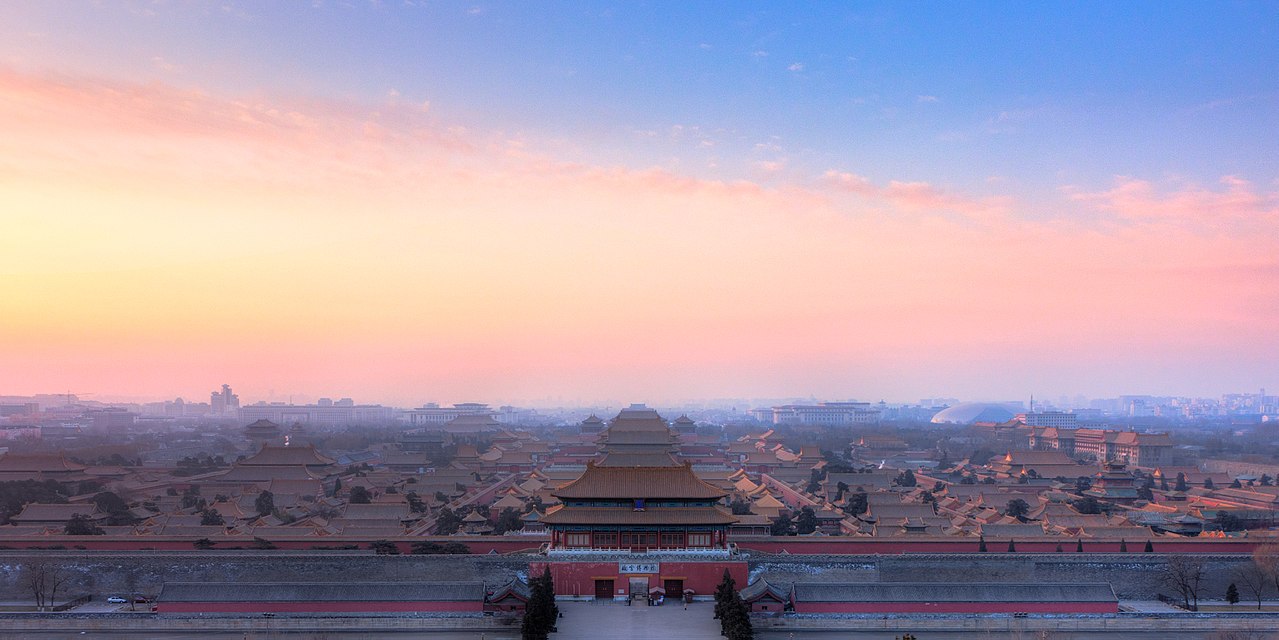
At the precise center of Beijing, surrounded by a moat 52 meters wide and walls 10 meters high, lies the largest and most complete imperial palace complex in the world. The Forbidden City — known in Chinese as 紫禁城 (Zǐjìnchéng), the Purple Forbidden City — covers 72 hectares and contains 980 surviving buildings with 8,886 rooms. For nearly five hundred years, from 1420 to 1912, it served as the seat of supreme power in China, the home of 24 emperors of the Ming and Qing dynasties, and the ceremonial heart of the world's most enduring civilization (Barmé, 2008).
The city was "forbidden" in the most literal sense. No one could enter or leave without the emperor's permission. The walls separated the Son of Heaven from the common world as completely as the moat separated the palace from the city. Within those walls, an emperor could live his entire life without ever setting foot on ordinary ground. Thousands of eunuchs, concubines, guards, and servants inhabited this enclosed world, governed by rituals so elaborate that the simple act of the emperor eating breakfast required the coordination of dozens of attendants.
To stand in the Forbidden City today is to confront the sheer ambition of imperial China's vision of order. Every gate, every courtyard, every roof tile was placed according to principles of cosmology, geomancy, and political symbolism that transformed architecture into a statement about the nature of the universe itself. The palace was not merely a building; it was a diagram of heaven rendered in wood, stone, and glazed ceramic.
Building the Impossible
The Forbidden City was commissioned in 1406 by the Yongle Emperor, the same ruler who sent Zheng He's treasure fleet across the Indian Ocean. Moving the capital from Nanjing to Beijing was a bold strategic decision — it placed the center of government closer to the northern frontier, where Mongol threats remained constant — but it required the construction of an entirely new imperial complex on a monumental scale.
The logistics were staggering. Over one million laborers worked on the project over fourteen years. Timber was sourced from forests in Sichuan and Yunnan, more than 1,500 kilometers away, and floated down rivers to Beijing. The massive stone slabs that pave the ceremonial avenues were quarried from Fangshan, 70 kilometers southwest of the capital, and dragged to the site on artificial ice roads during winter — workers poured water on the road ahead of the sledges and let it freeze into a slick surface. A single slab behind the Hall of Preserving Harmony weighs over 200 tons (Yu, 2012).
The bricks came from kilns in Shandong and were individually inspected; any brick that rang with an impure tone when struck was rejected. The golden-yellow glazed tiles that crown every major roof were fired in imperial kilns and reserved exclusively for the emperor's use — the color yellow symbolized the center of the cosmos and was forbidden to commoners. The result was a complex of almost supernatural perfection, where every material and every measurement served both practical and symbolic purposes simultaneously.
Architecture as Cosmology
The Forbidden City is not merely a palace but a cosmological instrument. Its design embodies the ancient Chinese understanding of the universe, in which heaven is round, earth is square, and the emperor stands at the point where the two intersect. The complex is oriented precisely along a north-south axis — the same axis that runs through the Bell Tower and Drum Tower to the north and the Temple of Heaven to the south, organizing the entire city of Beijing around a single cosmic line.
The number nine, considered the most auspicious number in Chinese numerology because it represents the pinnacle of yang energy, pervades the design. The main gates have 81 brass studs arranged in 9 rows of 9. The most important buildings sit on platforms with 9 levels. The corner towers each have 9 beams and 18 columns — multiples of 9. Even the total number of rooms was traditionally said to be 9,999 and a half — one half-room short of the 10,000 rooms that legend attributed to the palace of heaven, because no earthly ruler could presume to equal the celestial court (Steinhardt, 1990).
Colors, too, carry precise meaning. Yellow roofs signify imperial authority. Red walls represent happiness and good fortune. The green-roofed library, the Wenyuange, uses that color because green represents water in the five-elements system, and water protects against fire — the perennial enemy of wooden buildings. White marble terraces evoke purity. Black tiles on certain northern structures invoke water symbolism for the same protective reason. Nothing in the Forbidden City is accidental; every visual element participates in a vast symbolic language that literate visitors were expected to read as fluently as they read written characters.
"Heaven and humanity are one."
Core principle of Chinese cosmology, attributed to Dong ZhongshuDiscuss with Jason
Want to talk this article through?
Jason discusses the article with you, quizzes you on it and teaches you words from it.
Sign in free to ask. New accounts start with 300 AI credits.
The Outer Court: Stage of Power
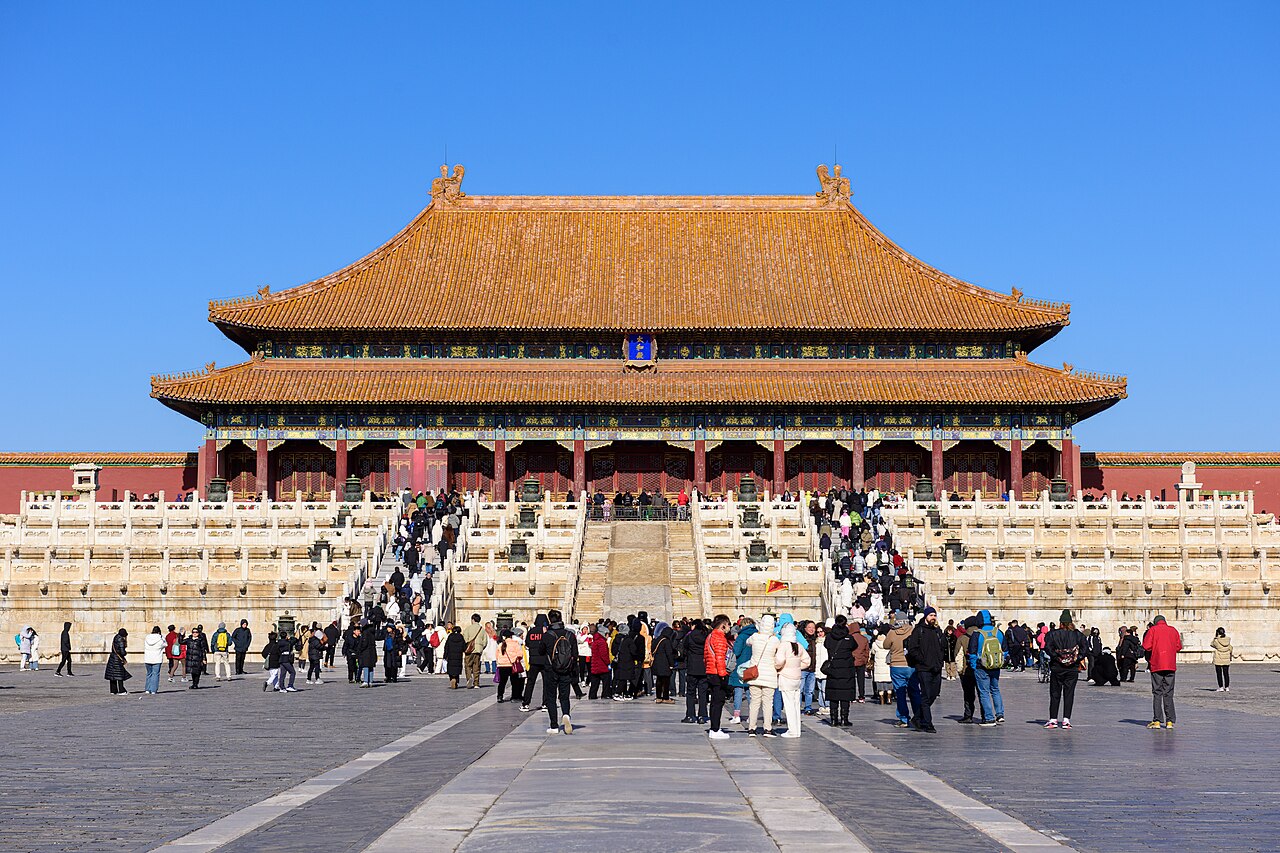
The Forbidden City is divided into two fundamental zones: the Outer Court and the Inner Court. The Outer Court, occupying the southern portion of the complex, was the stage for the public exercise of imperial power. Its three great halls — the Hall of Supreme Harmony, the Hall of Central Harmony, and the Hall of Preserving Harmony — sit atop a three-tiered marble terrace that elevates them above the surrounding courtyards like altars above a congregation.
The Hall of Supreme Harmony, the Taihedian, is the largest and most important building in the entire complex. It is where emperors were crowned, where New Year and winter solstice ceremonies were held, and where the emperor sat on the Dragon Throne to receive the prostrations of the entire court. The hall measures 64 meters wide, 37 meters deep, and 26 meters high, making it the largest surviving wooden structure in China. On ceremonial occasions, the vast courtyard before it could accommodate tens of thousands of officials arranged in precise hierarchical order, their rank indicated by the bronze markers embedded in the pavement (Barmé, 2008).
The experience of approaching the Hall of Supreme Harmony was carefully choreographed to overwhelm. A minister arriving for an imperial audience would pass through a series of progressively grander gates, each one requiring him to wait, present credentials, and advance through spaces of increasing scale. By the time he reached the hall itself and prostrated before the throne, he had been psychologically reduced to insignificance — a deliberate architectural effect that reinforced the absolute nature of imperial authority. The Forbidden City did not merely house power; it performed it.
"Under all of heaven, there is no land that is not the king's."
Book of Odes (Shijing), "Bei Shan"The Purple Star
The Chinese name for the Forbidden City — 紫禁城, Zǐjìnchéng — contains layers of meaning that no English translation fully captures. The character 紫 (zǐ, purple) refers not to the color of the buildings but to Polaris, the North Star, which in Chinese astronomy is called the Purple Star (紫微星, Zǐwēi Xīng). Ancient astronomers identified the circumpolar region around Polaris as the Purple Forbidden Enclosure (紫微垣), the celestial palace where the Heavenly Emperor resided. By naming the earthly palace after the celestial one, the Ming builders declared that the emperor's home was the terrestrial counterpart of heaven's throne room.
The concept of 禁 (jìn, forbidden) reinforced this cosmic connection. Just as the Purple Forbidden Enclosure in the sky was the exclusive domain of the Heavenly Emperor, surrounded by constellations representing ministers and guards, so the earthly Forbidden City was reserved exclusively for the Son of Heaven. The walls were not merely security measures; they were symbolic boundaries separating the sacred from the profane, the cosmic from the mundane.
This astronomical symbolism extended to the layout of the complex. The Meridian Gate, the main southern entrance, is oriented to align with the meridian — the imaginary line running from north to south through the celestial pole. The emperor, seated on his throne on the central axis, was symbolically positioned at the exact point where heaven and earth intersected. He was, in architectural terms, the pivot of the cosmos — the still point around which the entire empire, and indeed the universe, revolved.
From Palace to Museum
The Forbidden City ceased to be a functioning imperial residence on February 12, 1912, when the last emperor of China, the six-year-old Puyi, was forced to abdicate. The Republic of China allowed the imperial family to remain in the Inner Court for another twelve years, creating the surreal spectacle of a deposed dynasty living in half a palace while the other half was converted into a public museum. In 1924, Puyi was finally expelled, and the Palace Museum was formally established in 1925 (Barmé, 2008).
The twentieth century was not kind to the Forbidden City. During the Japanese invasion of the 1930s, thousands of the most valuable artifacts were packed into crates and evacuated south — beginning an odyssey that would eventually see them end up in the National Palace Museum in Taipei, where they remain today. The split between the Beijing and Taipei collections is one of the enduring cultural consequences of the Chinese Civil War. During the Cultural Revolution of the 1960s, the Forbidden City itself narrowly escaped destruction; Premier Zhou Enlai reportedly stationed troops at the gates to prevent Red Guards from entering and destroying what they considered a symbol of feudal oppression.
Today the Palace Museum is the most visited museum in the world, welcoming over 17 million visitors annually. The complex is a UNESCO World Heritage Site and the subject of ongoing restoration projects that seek to preserve its wooden structures against the ravages of time, pollution, and the sheer weight of human traffic. For modern visitors, the Forbidden City is no longer a seat of power but a monument to the civilization that created it — a place where five centuries of imperial history can be read in wood, stone, and silence.
Quiz
What is the primary function of the Forbidden City's Outer Court?
Why was the Forbidden City referred to as 'forbidden'?
What does the color yellow symbolize in the Forbidden City?
What was the significance of the number nine in the Forbidden City's design?
Who commissioned the construction of the Forbidden City?
What does the character '紫' (zǐ) in the Forbidden City's Chinese name refer to?
How were the massive stone slabs transported to the Forbidden City site?
What happened to the Forbidden City during the Cultural Revolution?
Write your thoughts, then get feedback from Jason — you can turn any answer into a full discussion.
9. How does the design of the Forbidden City reflect the ancient Chinese understanding of the universe?
10. In what ways did the Forbidden City serve as both a symbol of power and a place of confinement?
Frequently Asked Questions
Common questions about The Forbidden City: Palace of Emperors
How many rooms does the Forbidden City have?
The Forbidden City contains 980 surviving buildings with 8,886 rooms spread across 72 hectares, making it the largest and most complete imperial palace complex in the world. The complex is surrounded by a 52-meter-wide moat and 10-meter-high walls. It served as the home and seat of power for 24 emperors of the Ming and Qing dynasties from 1420 to 1912.
Why was the Forbidden City called forbidden?
The Forbidden City was called "forbidden" because no one could enter or leave the palace grounds without the emperor's explicit permission. The Chinese name 紫禁城 (Zǐjìnchéng) literally means "Purple Forbidden City," with "purple" referring to the North Star (Ziwei Star) in Chinese cosmology, symbolizing the celestial palace of the heavenly emperor. The earthly palace was its mirror, equally sacred and off-limits to ordinary people.
How long did it take to build the Forbidden City?
The Forbidden City was built between 1406 and 1420, taking approximately 14 years to construct. It was commissioned by the Yongle Emperor, the same ruler who sent Zheng He's treasure fleet across the Indian Ocean. The project required an estimated one million workers and used materials sourced from across the empire, including massive timber from southwestern forests and marble from quarries outside Beijing.
What is the Forbidden City used for today?
Today the Forbidden City operates as the Palace Museum (故宫博物院), one of the most visited museums in the world, attracting millions of visitors annually. It houses an immense collection of imperial art, artifacts, and antiquities spanning Chinese civilization. The complex was designated a UNESCO World Heritage Site in 1987 and has undergone extensive restoration to preserve its historic architecture.
What is the symbolism behind the Forbidden City's design?
Every element of the Forbidden City's design reflects Chinese cosmological and political symbolism. The complex faces south, the direction of imperial authority. The number nine, considered the most powerful yang number, appears throughout in door studs, roof figures, and architectural proportions. The progression from outer public courts to inner private quarters mirrors the Confucian hierarchy from state affairs to family life.