The fire went out last night. You are supposed to wait five days. We have waited one night. Since last night we have had the side holes open the whole way up, to pull the heat out fast. Everybody standing on this hill knows one night is not five days. Nobody says it. Wood, clay, the men we hired — eleven strings of cash, and we borrowed all of it. The interest comes due before we can fire again. So we open early, and we all agree not to mention it.
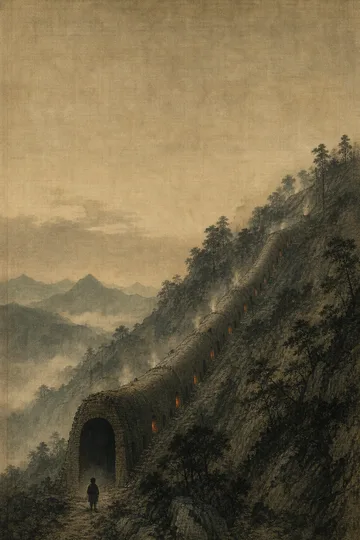
The kiln is forty paces long and it goes straight up the hill. They call it a dragon kiln, because a fire laid on a slope climbs itself. The village has come up to watch. They are standing further back than they need to. Old Fang from the next slope lifts his chin at me. "Ash. Your grandmother wants you." Nobody laughs. They stopped laughing years ago. My father named me in a bad year, as a joke. He drowned that spring, before he could take it back.
My grandmother is at the bottom of the slope with her hands inside her sleeves. She does not say anything about the fire, or about my father, or about luck. "Fifth door," she says. "Twenty-two boxes. Front row eleven, back row eleven." “二十二个。”我说。 "Front row eleven," she says again. "Back row eleven." She says numbers twice. She has always said numbers twice.
The door they have knocked out is a slot two hands wide. My brother is sixteen and too wide at the shoulder — he gets as far as his elbows. My mother could fit. My mother's hands are worth more than mine. She throws pots. I carry things and count them. So it is me. I go in because I fit. I am eleven. I am not going to pretend I hate it.
My brother pours water over my straw sandals until they stop steaming. My mother wets a cloth and ties it over my mouth and nose. She puts the iron hook in my hand and closes my fingers around it. "Do not hurry," she says. Nobody says be careful. Careful is not a thing you say at a kiln mouth.
Heat from a bonfire touches one side of you. In here there are no sides. It comes off the bricks. It comes off the floor. It comes off the stacked boxes, a hand-width from each shoulder. It pushes on my eyes from behind them. The fire is out. The fire is still there.
Her voice arrives from a long way down the slope, and it is very small.
“灰。” “在。”我说。 “前面一排。” “十一个。”我说。 “后面一排。” “十一个。”我说。 “好。”她说。
That is the whole conversation. That is how we talk in here.
The bowls travel inside clay boxes, so that ash flying off the fire cannot land on the glaze. I lift a lid. I look. I put the lid down. I say a word. 青。 青。 Grey. Dead, that one. It goes on the heap. 青。
While my hands work I do the arithmetic, because I always do the arithmetic. Good pieces, times what the merchant paid last autumn, against eleven strings. It does not reach. I do it again with the same numbers and it does not reach again.
The sixth box has a bowl with a thin grey bloom along one side. That side never got the fire. It is not good. It is not dead either. It is the kind of thing my grandmother decides. "Sixth box," she calls. “青。”我说。 My hand puts the lid down. I notice afterwards that my hand did it before I decided anything. It is one bowl. It is nothing. I go on to the seventh box.
The eighth box, and I stop breathing, which in here is a mistake. It is the colour of the sky when the rain has stopped and the road is not dry yet. I have heard old men argue about this colour for a whole evening, the way other men argue about wine. I have never seen it. My father never saw it.
Eleven strings of cash. The clerk in the spring. My mother's hands. All of it is answered by this one bowl, and I am the one who found it. My hands are shaking. I notice that the shaking is the danger.
I turn it over to look at the foot, because that is what you do. The foot is the only part of any of this I am fully trusted with. There is a crack. It runs up under the glaze, where it cooled too fast. It is as thin as a hair. I look at it for a long time.
I put my thumb over it. This does nothing. I know it does nothing. I do it anyway. I am now the only person on this hill who knows we are not saved.
Behind me, something breathes out. Warm, and slow, and close enough to move the wet hair on the back of my neck. Behind me is the sixth door. The sixth door is still bricked. We open from the bottom up, so nothing above me has been let out. It is still hot enough in there to cook a person in about as long as it takes to say so. I do not turn round.
Down the slope, very small, my grandmother calls for the eighth box. "Eighth box," she says. "Count." The thing behind me does not move, and does not go away. I hear my own voice say a number.