
Skip to content

For learners

Writing and stroke order

rì jī yuè lěi — “Day by day, month by month, it accumulates”

Trace characters in the right order, then photograph what you wrote on paper for AI feedback.

6 min read

Not what you were looking for?

Handwriting is the part people skip, and then wonder why characters will not stick. Writing a character is the only practice that forces you to know every component rather than recognise the silhouette — which is exactly the difference between "I have seen this" and "I know this".

The writing studio

/writing animates each character stroke by stroke and then asks you to trace it. You work through characters, set phrases and proverbs, building the muscle memory that recognition alone never gives you.
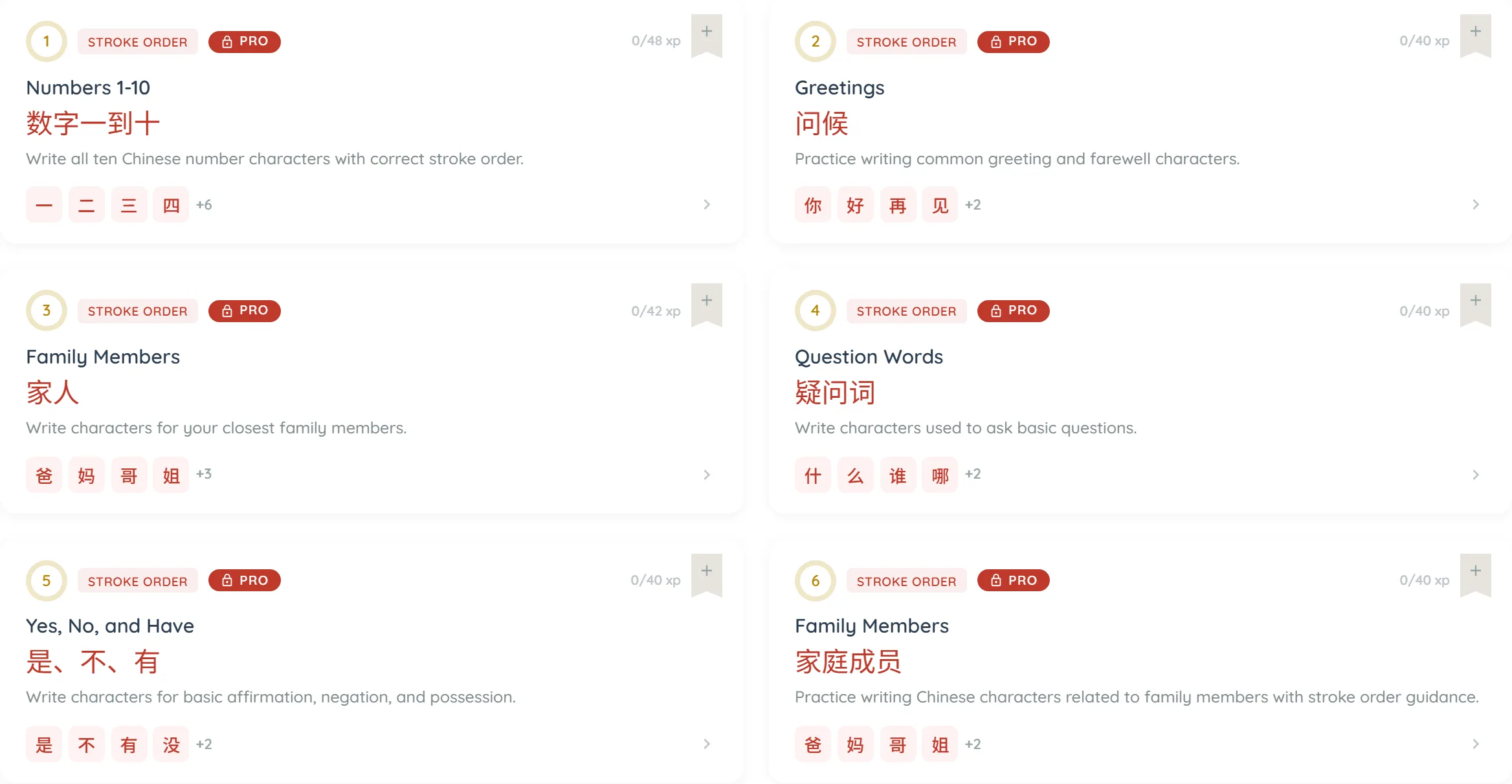
Six numbered practice cards in the writing studio, two to a row. Every card carries a STROKE ORDER tag, a PRO badge with a padlock and an XP counter reading between 0/40 and 0/48, an English and a Chinese title — Numbers 1-10 数字一到十, Greetings 问候, Family Members 家人, Question Words 疑问词, Yes, No, and Have 是、不、有, Family Members 家庭成员 — a one-line description, and four character tiles followed by a "+2" to "+6" count for the characters not shown.
The studio is stocked as themed sets rather than loose characters, so a sitting is the ten numerals or the greeting words; the four tiles on a card are a preview, and the "+6" is the rest of the set.
  • Watch the animationEvery stroke in order, at a speed you can follow. Replay as often as you like.
  • Trace itOn the character itself. Wrong stroke order is caught as you go rather than at the end.
  • Then write it unaidedThe step that matters. Tracing teaches the shape; writing from memory teaches the character.

Why stroke order is not pedantry

It looks like an arbitrary rule and it is not. Correct order makes a character come out balanced, makes it legible when written quickly, and — the practical one — is how handwriting input on a phone recognises what you drew.

It is also how you remember. Characters written in a consistent order become one motion instead of a dozen unrelated marks, which is why the same character takes three attempts to learn with order and thirty without.

Writing inside lessons

Every HSK lesson has its own Writing section covering the characters that lesson introduces, with the same animation and tracing. That is the version to use while working through the course; the studio is for practising characters you choose.

Getting your handwriting marked

Separate from tracing, and it does cost credits. Two features work together: 8 credits generates a sentence for you to write out, and 9 credits reads what you actually wrote and marks it.

That second one is the most expensive single action on a learner account, because it is a vision model looking at your image. Worth it occasionally as a check; not something to run every day.

The free references
Kangxi radicalsThe 214 building blocks, with stroke orderStroke order rulesThe eight basic strokes and the rules that order themCharacter formationThe six ways characters are built — 六书
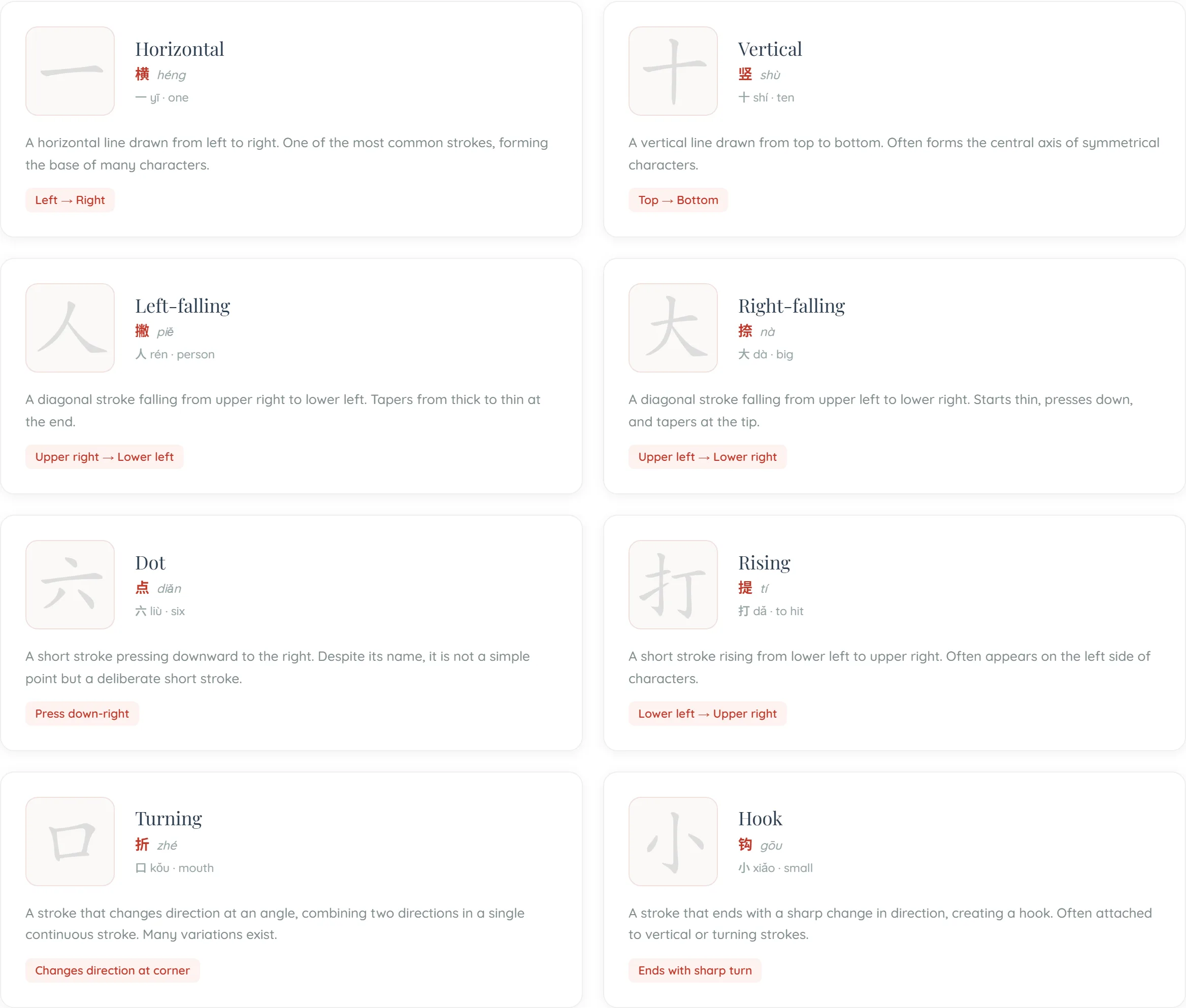
The eight basic strokes from the stroke-order reference, laid out as cards two to a row. Every card opens with the example character drawn large and pale grey in a rounded tile, then the English name, the Chinese name in red with its pinyin, the example character read out as hanzi, pinyin and meaning, a two-sentence description of how the stroke is drawn, and a pink pill giving the movement: Horizontal 横 héng, 一 yī · one, "Left → Right"; Vertical 竖 shù, 十 shí · ten, "Top → Bottom"; Left-falling 撇 piě, 人 rén · person, "Upper right → Lower left"; Right-falling 捺 nà, 大 dà · big, "Upper left → Lower right"; Dot 点 diǎn, 六 liù · six, "Press down-right"; Rising 提 tí, 打 dǎ · to hit, "Lower left → Upper right"; Turning 折 zhé, 口 kǒu · mouth, "Changes direction at corner"; Hook 钩 gōu, 小 xiǎo · small, "Ends with sharp turn". The descriptions are practical rather than formal — the dot card warns that "despite its name, it is not a simple point but a deliberate short stroke".
Every stroke is anchored to a character you can already write — 一, 十, 人, 大, 六, 打, 口, 小 — so the name arrives attached to something concrete rather than as an abstraction. The pills are the part to read closely: five of the eight are start-to-end directions you can simply follow, but the dot, the turning stroke and the hook get a move instead of a path — "Press down-right", "Changes direction at corner", "Ends with sharp turn" — and those three are the ones to watch animated rather than read about.

Common questions

No. The stroke animations and tracing are free of credits — the data is stored, not generated. Only an AI marking your own handwriting costs anything.

Continue learning

What each AI feature costsA price list in credits — podcasts, images, pronunciation, handwriting, study plans and the rest.Using the dictionarySearch 21,000 entries by character, pinyin or meaning, and read everything a single entry holds.