
Podcast


Podcast: Chinese Wedding Traditions: From Matchmaker to Modern Romance
Listen to Jason & Amy discuss Chinese Wedding Traditions: From Matchmaker to Modern Romance
New here?
The Six Rites of Zhou Dynasty Marriage
The foundational framework of traditional Chinese marriage is the system of Six Rites (liu li), codified in the ritual texts of the Western Zhou dynasty (1046–771 BCE) and subsequently elaborated in the canonical Book of Rites (Liji). These six stages — proposal (nacai), inquiry into the bride's name and birth details (wenming), divination to confirm compatibility (naji), presentation of betrothal gifts (nazheng), selection of the wedding date (qingqi), and the bride's procession to the groom's home (qinying) — established a template for marital procedure that shaped Chinese wedding practice for nearly three thousand years. Each stage was governed by precise rules of etiquette, timing, and symbolic gesture, reflecting the Confucian conviction that the proper ordering of human relationships required formal ritual expression. As Ebrey (1991) demonstrated in her landmark study of Chinese marriage in historical perspective, the Six Rites were not merely ceremonial formalities but served essential social functions: they publicized the union, established its legitimacy, defined the economic terms of the alliance, and ritually incorporated the bride into her new family.
The first three rites focused on establishing the match and confirming its suitability. The proposal (nacai) was initiated by the groom's family, who dispatched a matchmaker bearing a live goose — a bird whose lifelong fidelity to its mate symbolized the hoped-for constancy of the marriage — to the bride's family to express interest. The inquiry (wenming) sought the bride's full name and the eight characters (bazi) of her birth — year, month, day, and hour — which were then submitted to a fortune teller for the crucial step of divination (naji). The fortune teller compared the couple's bazi to determine whether their elemental profiles (based on the five elements of wood, fire, earth, metal, and water) were harmoniously matched or dangerously conflicting. An unfavorable reading could terminate the match entirely, regardless of the families' wishes, reflecting the deep conviction that cosmic forces played an active role in determining human compatibility. This divinatory dimension distinguished Chinese marriage from purely contractual arrangements, imbuing the process with a metaphysical seriousness that elevated it above mere social convention (Watson & Ebrey, 1991, pp. 25–48).
The final three rites formalized the economic arrangements and culminated in the wedding itself. The presentation of betrothal gifts (nazheng) was the most materially significant stage, involving the transfer of bride-price from the groom's family to the bride's family — a practice that served both as compensation for the loss of a daughter's labor and as tangible proof of the groom's family's financial capacity. The gifts were specified by custom and varied by region and social class, but typically included money, bolts of silk or cloth, food items, and pairs of auspicious objects. The selection of the wedding date (qingqi) required consultation with an almanac to identify a day deemed propitious by the complex Chinese calendrical system, avoiding dates that fell on inauspicious conjunctions or conflicted with the couple's bazi. The final rite, the groom's procession to fetch the bride (qinying), was the most elaborate and publicly visible stage of the entire process, involving a noisy cavalcade of musicians, lantern bearers, and attendants that served as a public announcement of the marriage and a demonstration of the groom's family's status and generosity (Ebrey, 1991, pp. 55–78).
The Matchmaker and the Art of Betrothal
The matchmaker (meiren or meipo) occupied a position of extraordinary social importance in traditional Chinese society, serving as the essential intermediary without whom no respectable marriage could be arranged. The classic formulation, enshrined in Confucian ritual texts, was unequivocal: "Without a matchmaker, there is no marriage" (wu mei bu cheng hun). This insistence on mediation reflected both practical and moral considerations. Practically, direct negotiation between the two families risked the loss of face that would result from a rejected proposal, and the matchmaker's involvement allowed both sides to explore the possibility of a match without committing themselves prematurely. Morally, the matchmaker's role preserved the modesty and propriety expected of young women in a society that strictly limited contact between unmarried men and women. Professional matchmakers, typically older women with extensive social networks, earned their livelihoods by accumulating detailed knowledge of eligible families in their district — their wealth, reputation, the characters and appearances of their marriageable children — and identifying compatible pairings that served both romantic and strategic purposes (Watson & Ebrey, 1991, pp. 52–75).
The betrothal process that followed a successful match involved elaborate exchanges of gifts that served both symbolic and economic functions. The groom's family's bride-price (pin li) typically included specified quantities of money, tea, wine, foodstuffs, jewelry, and bolts of fabric, presented in even-numbered sets (since odd numbers were associated with funerals and inauspicious occasions). Tea held special significance in the betrothal exchange because the tea plant, which cannot be transplanted once established, symbolized fidelity and the permanence of the woman's transfer from her natal to her marital family — hence the traditional euphemism for betrothal gifts was "tea ceremony" (cha li) and an engaged woman was said to have "accepted tea" (shou cha). The bride's family reciprocated with a dowry (jia zhuang) that accompanied the bride to her new home, typically comprising furniture, bedding, clothing, jewelry, and household goods, the quantity and quality of which reflected the bride's family's wealth and their investment in their daughter's comfort and status in her new household. As Ebrey (1993) showed, the relative balance of bride-price and dowry shifted significantly over time, with dowry inflation becoming a major concern by the Song dynasty as families competed to secure advantageous matches for their daughters.
The negotiation of betrothal gifts was a delicate diplomatic exercise that required the matchmaker's full repertoire of tact, persuasion, and strategic ambiguity. Setting the bride-price too high risked insulting the groom's family or pricing them out of the match; setting it too low suggested that the bride's family undervalued their daughter or was desperate to arrange the marriage. The matchmaker navigated these sensitivities by framing monetary discussions in the language of custom and propriety rather than naked economics, emphasizing that the gifts were expressions of sincerity and respect rather than commercial transactions. In practice, however, betrothal negotiations could be intensely mercenary, particularly in periods of economic scarcity or when significant disparities of wealth or status existed between the two families. The matchmaker's commission, typically a percentage of the bride-price plus gifts of food and cloth from both families, created an incentive structure that favored the successful completion of matches — a reality that gave rise to the satirical stereotype of the matchmaker as a silver-tongued exaggerator who embellished the virtues and concealed the defects of her clients. This ambivalent cultural image is memorably captured in traditional opera and fiction, where the matchmaker figure appears as a simultaneously indispensable and faintly disreputable character (Watson & Ebrey, 1991, pp. 78–98).
"By the command of the parents and the words of the matchmaker."
Mencius (Mengzi), 4th century BCEThe Wedding Day: Ceremony and Celebration
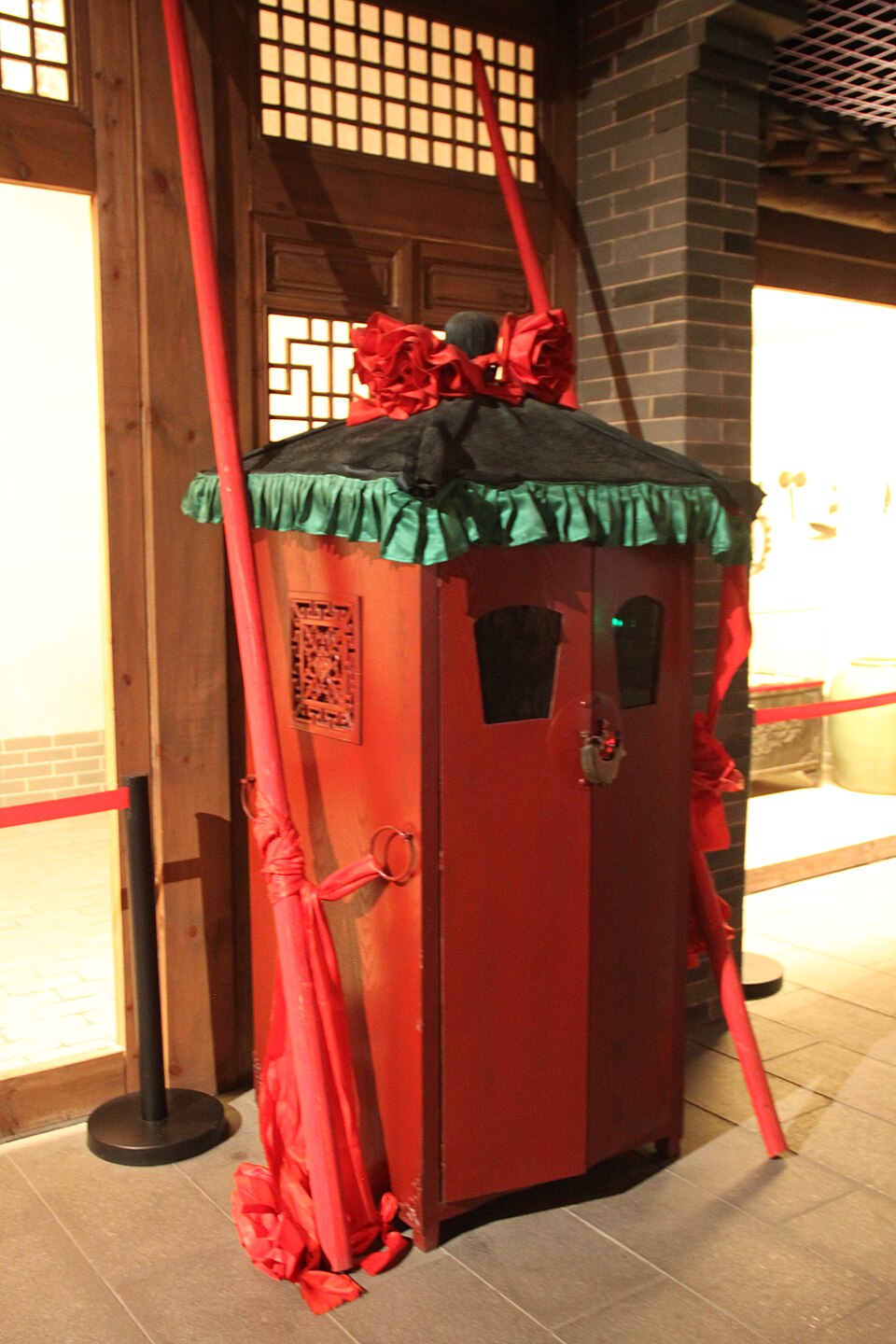
The traditional Chinese wedding day was an elaborate production that could span an entire day and night, proceeding through a carefully orchestrated sequence of rituals, each laden with symbolic meaning and governed by precise rules of timing and procedure. The day began before dawn in both households: the bride underwent an elaborate toilette that included the ritual of "combing the hair" (shu tou), in which a respected older woman combed the bride's hair while reciting four blessings corresponding to each stroke — for a harmonious marriage, for many children, for longevity, and for wealth. The groom, meanwhile, prepared to lead the procession (yingqin) to the bride's home, donning ceremonial robes and a hat decorated with cypress leaves and red silk. The bridal sedan chair (hua jiao), an enclosed, elaborately decorated conveyance borne by four or eight carriers, was the centerpiece of the procession — its red curtains concealed the bride from public view, preserving the mystery and anticipation that would culminate in the unveiling ceremony at the groom's home. The procession itself was a noisy, colorful spectacle involving musicians playing suona horns and percussion, attendants carrying lanterns and banners, and bystanders shouting blessings and setting off firecrackers (Ebrey, 1991, pp. 98–125).
Arriving at the bride's home, the groom faced a series of ritualized obstacles collectively known as "gate crashing" (chuangmen), a custom that tested his sincerity, wit, and generosity while providing entertainment for the bride's family and friends. The bridesmaids barricaded the door and demanded that the groom perform feats of varying absurdity — singing love songs, doing push-ups, answering riddles, or distributing red envelopes of increasing denominations — before allowing him entry. This playful ordeal, which survives robustly in modern Chinese weddings, served the serious social function of publicly demonstrating the groom's determination and the bride's family's reluctance to part with their daughter, dramatizing the emotional cost of the transfer at the heart of the patrilocal marriage system. Once admitted, the groom paid formal respects to his future in-laws and coaxed the bride from her room, often finding her hiding or weeping — the ritual tears (ku jia) expressing grief at leaving her natal family, whether genuinely felt or ceremonially performed. The departure of the bride from her parents' home was one of the most emotionally charged moments in the entire wedding sequence, and bridal laments — songs of sorrow and farewell composed and performed by the bride herself — constitute a rich genre of Chinese folk literature documented across numerous regional traditions (Watson & Ebrey, 1991, pp. 105–128).
The ceremonies at the groom's home constituted the formal heart of the wedding. The most important of these was the ritual of "three bows" (san bai): the couple bowed first to heaven and earth, then to the groom's parents, and finally to each other, a sequence that established the metaphysical, familial, and conjugal dimensions of the union in order of descending priority. The tea ceremony (jing cha) followed, in which the bride served tea to her new parents-in-law and received in return gifts of jewelry and red envelopes, formally marking her incorporation into the groom's family. The wedding banquet, often the most lavish meal the host family would ever serve, featured prescribed courses of symbolic foods: a whole roasted pig representing the bride's virginity, lobster whose Chinese name (longxia) contains the word for dragon, phoenix chicken (a dish arranged to resemble the auspicious phoenix), and sweet lotus seed soup symbolizing the wish for many children. The revelry continued late into the night with the custom of "disturbing the bridal chamber" (nao dongfang), in which guests subjected the newlyweds to a series of teasing games and challenges designed to ease the awkwardness of the wedding night through communal laughter and shared embarrassment (Ebrey, 1993, pp. 135–162).
"I hold your hand, and I shall grow old together with you."
Book of Songs (Shijing), "Drumming" (击鼓)Discuss with Jason
Want to talk this article through?
Jason discusses the article with you, quizzes you on it and teaches you words from it.
Sign in free to ask. New accounts start with 300 AI credits.
Regional Variations in Wedding Custom
The vast geographic and cultural diversity of China has produced a remarkable array of regional wedding traditions that elaborate upon, modify, or occasionally contradict the classical Six Rites framework. In the Hakka communities of Guangdong, Fujian, and Jiangxi provinces, the bride traditionally wore a distinctive phoenix crown (fengguan) and an embroidered cape that transformed her into a figure of almost regal splendor, a costume that reflected the Hakka community's fierce pride in cultural preservation and its memory of northern aristocratic origins. Hakka weddings also featured the tradition of the "crying marriage song" (ku jia ge), in which the bride performed elaborate laments for weeks before the wedding, singing of her sorrow at leaving her parents, her anxiety about life in a strange household, and her gratitude for her upbringing — a tradition that produced a sophisticated body of women's folk poetry that scholars have increasingly recognized as an important literary genre in its own right (Ebrey, 1991, pp. 168–185).
In the water towns of the Jiangnan region — the area around the Yangtze River delta encompassing parts of Jiangsu, Zhejiang, and Anhui provinces — weddings incorporated distinctive aquatic elements reflecting the region's landscape and culture. The bridal procession often traveled by boat along the network of canals that connected the region's towns and villages, the elaborately decorated wedding barge proceeding through waterways lined with cheering neighbors and accompanied by boats carrying musicians, dowry goods, and attendants. The Jiangnan tradition placed special emphasis on the dowry, which was publicly displayed in an elaborate procession (fa jia zhuang) that wound through the streets of the bride's hometown, allowing the community to assess the family's generosity and wealth. The contents of the dowry were meticulously catalogued and announced by a herald, transforming the procession into a public accounting of the bride's family's investment in the marriage. In Cantonese wedding traditions of Guangdong, the ritual of "combing the hair" was elaborated into a major ceremony performed on the eve of the wedding, with specific songs, prayers, and symbolic objects associated with each stroke of the comb (Watson & Ebrey, 1991, pp. 145–168).
The minority peoples of China's southwestern provinces practice wedding traditions that differ dramatically from the Han Chinese norm. Among the Mosuo people of Yunnan, the traditional system of "walking marriage" (zou hun) dispensed with the wedding ceremony entirely: partners maintained separate households, and the man visited the woman at night, returning to his own mother's home in the morning. Children belonged to the mother's household, and the biological father had no formal parental role, his duties of care and discipline falling instead to the maternal uncle. This matrilineal, matrilocal system stood in sharp contrast to the patriarchal structure of Han Chinese marriage and fascinated both Chinese and Western anthropologists, who debated whether it represented a survival of an ancient social form or a unique adaptation to local ecological and economic conditions. Among the Miao (Hmong) people, courtship involved musical competitions and antiphonal singing between young men and women, and marriages could be initiated by the couple themselves rather than arranged by their parents — a degree of individual romantic agency that was largely absent from traditional Han Chinese marriage practice before the twentieth century (Ebrey, 1993, pp. 178–198).
Symbolic Meanings and Auspicious Objects
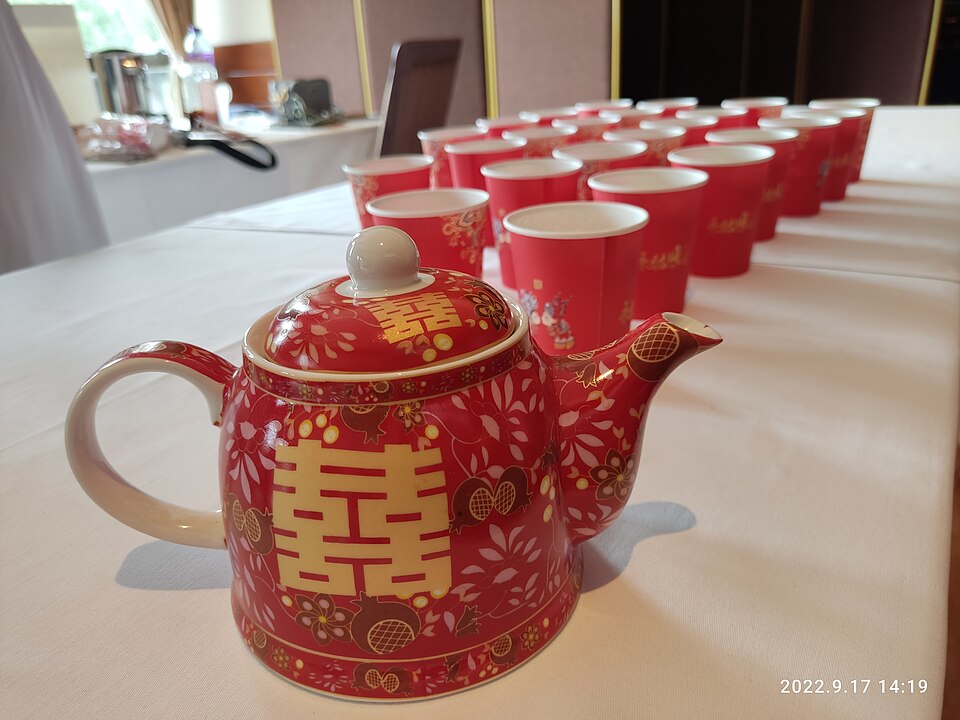
Chinese wedding traditions are saturated with symbolic meanings that transform every object, color, gesture, and food into a statement of aspiration, blessing, or protection against misfortune. The dominance of red — in the bride's dress, the decorations, the envelopes, the candles, and even the eggs distributed to announce the birth of a child — derives from its associations with joy, vitality, good fortune, and the power to repel evil spirits. The double happiness character (shuangxi), composed of two standard happiness characters (xi) placed side by side, appears on virtually every surface associated with a Chinese wedding, from the invitations and decorations to the bed linens and tableware. This character, according to legend, was invented by a Tang dynasty scholar who encountered his future wife when she completed the second half of a couplet he had posted — the joining of the two halves of the poem mirrored the joining of the two individuals in marriage. Whether historically accurate or not, the legend captures the essential symbolism of the double happiness character: the idea that the happiness of marriage is not simply individual joy doubled but a qualitatively new form of happiness that can only exist in union (Ebrey, 1991, pp. 202–218).
The bridal bed (hun chuang) was the focus of intense ritual attention, its preparation governed by precise rules designed to ensure the couple's fertility and happiness. The bed was made by a designated woman of good fortune (hao ming po) — typically a happily married mother of many children — who spread the sheets and quilts while reciting blessings for marital harmony and abundant offspring. Before the newlyweds retired, children were invited to roll on the bed in a practice called "rolling the bed" (gun chuang), a sympathetic magic ritual in which the presence of children on the marriage bed was believed to encourage the conception of children by the couple. Dates, peanuts, longans, and lotus seeds were scattered across the sheets, not for consumption but because the Chinese names of these four foods — zao, hua sheng, gui, and lianzi — form a phrase that sounds like "may you soon give birth to a noble son" (zao sheng gui zi). This playful yet earnest verbal-material punning exemplifies the broader Chinese cultural practice of embedding wishes and prayers in the texture of daily material life, creating a world in which objects speak and even the arrangement of dried fruit on a bedspread becomes an act of hope (Watson & Ebrey, 1991, pp. 175–195).
The wedding tea ceremony, though only one element among many in the traditional wedding day, has proven to be the most durable and universally practiced of all Chinese wedding rituals, surviving even in weddings that have otherwise adopted entirely Western formats. In the tea ceremony, the bride and groom kneel before the groom's parents and offer cups of tea, typically sweetened with dried dates or lotus seeds, addressing each family member by their proper kinship title — a ritual that simultaneously expresses filial respect, formally introduces the bride into the family hierarchy, and establishes the kinship terminology that will govern family relationships going forward. Each elder who receives tea responds with gifts, traditionally gold jewelry for the bride, and words of blessing and advice. The intimacy and emotional directness of the tea ceremony — the physical act of kneeling, the eye contact, the personal address — create moments of genuine feeling that many couples describe as the most meaningful part of their entire wedding experience, more affecting than the public spectacle of the banquet or the legal formality of the marriage registration. The tea ceremony's survival and continued vitality in an era when many other traditional wedding customs have been abandoned or reduced to nostalgic decoration testifies to its capacity to express enduring values of gratitude, respect, and family solidarity in a form that feels authentic rather than archaic (Ebrey, 1993, pp. 215–232).
"A hundred years of cultivation to share a boat ride; a thousand years to share a pillow."
Traditional Chinese proverb on fate and marriageModern Chinese Weddings: Blending East and West
The transformation of Chinese wedding practice over the past century represents one of the most dramatic instances of cultural hybridization in modern history. The Republican period (1912–1949) saw the first systematic efforts to reform traditional marriage practices, driven by May Fourth intellectuals who viewed arranged marriage, bride-price, and matchmaker mediation as symbols of feudal oppression that denied individual freedom and perpetuated patriarchal control. The New Life Movement of the 1930s promoted "civilized weddings" (wenming jiehun) that adopted Western elements — white dresses, church-like settings, exchange of rings — while retaining selected Chinese customs such as the tea ceremony and the wedding banquet. The Communist revolution of 1949 brought far more radical changes: the Marriage Law of 1950 abolished arranged marriage, bride-price, child betrothal, and polygamy, establishing free-choice marriage and gender equality as legal principles. During the Cultural Revolution, wedding celebrations were stripped to austere minimalism, with couples exchanging copies of Mao's Little Red Book in place of traditional gifts and holding their ceremonies at their work units rather than at home or in restaurants (Ebrey, 1993, pp. 245–268).
Contemporary Chinese weddings have evolved into remarkably creative amalgamations of Chinese tradition, Western convention, and modern Chinese innovation. A typical urban Chinese wedding in the 2020s might begin with a morning gate-crashing game rooted in folk custom, proceed through a Western-style church or garden ceremony with white gown and veil, continue with a traditional tea ceremony in a hotel suite, and culminate in a lavish banquet at which the bride changes into a red qipao or kua for the toasting rounds. The wedding photography industry has developed into a massive business, with couples commissioning elaborate pre-wedding photo shoots in scenic locations, themed studios, or even overseas destinations — a practice that reflects the contemporary Chinese emphasis on wedding images as curated representations of romantic aspiration. The cost of weddings has escalated dramatically, with average spending in major cities regularly exceeding several hundred thousand yuan, driven by bride-price inflation, dowry competition, and the social pressure to stage an event that impresses the extended family and wider community (Watson & Ebrey, 1991, pp. 210–232).
Despite these transformations, certain core elements of Chinese wedding culture have proven remarkably resilient. The tea ceremony remains nearly universal, even among couples who describe themselves as thoroughly modern and have no interest in other traditional customs. The wedding banquet retains its central importance as the occasion that formalizes the marriage in the eyes of the community, and the social dynamics of banquet planning — the careful calibration of guest lists, seating arrangements, and table assignments according to the relative status and closeness of each relationship — would be entirely recognizable to a Song dynasty host. Red envelopes containing cash gifts remain the standard form of wedding present, and the amounts given are carefully recorded to maintain the complex web of reciprocal obligations that structures Chinese social life. Even the bride-price, officially abolished in 1950 and periodically denounced by government campaigns, has made a robust comeback in many regions, particularly in rural areas where the scarcity of marriageable women (a consequence of the one-child policy's gender imbalance) has driven bride-prices to unprecedented levels. The persistence of these practices suggests that Chinese wedding traditions are not merely decorative survivals but continue to serve essential social functions — marking status, building alliances, expressing values, and managing the complex transition of individuals between families — that transcend the particular cultural forms in which they are expressed (Ebrey, 1993, pp. 275–295).
Quiz
What was the primary role of the matchmaker in traditional Chinese weddings?
Which of the Six Rites involved the presentation of betrothal gifts?
What symbolic meaning does the tea plant hold in Chinese betrothal traditions?
How did the Communist revolution of 1949 affect Chinese wedding practices?
What is the significance of the 'three bows' ritual in a traditional Chinese wedding?
Which color is predominantly used in Chinese weddings for its association with joy and good fortune?
What modern trend in Chinese weddings involves elaborate pre-wedding photo shoots?
What is the primary purpose of the bridal sedan chair in a traditional Chinese wedding procession?
Write your thoughts, then get feedback from Jason — you can turn any answer into a full discussion.
9. How do you think the blend of traditional and modern elements in contemporary Chinese weddings reflects broader cultural changes in China?
10. Why might the tea ceremony have remained a consistent element in Chinese weddings despite many other traditional customs changing?
Frequently Asked Questions
Common questions about Chinese Wedding Traditions: From Matchmaker to Modern Romance
What are the Six Rites of a traditional Chinese wedding?
The Six Rites (liu li) are the formal stages of traditional Chinese marriage codified during the Zhou dynasty: proposal (nacai), inquiry into the bride's details (wenming), divination for compatibility (naji), presentation of betrothal gifts (nazheng), selection of the wedding date (qingqi), and the bridal procession (qinying). These rites governed Chinese marriage customs for nearly three thousand years.
Why do Chinese brides wear red instead of white?
In Chinese culture, red symbolizes good fortune, happiness, and prosperity, making it the traditional color for joyous occasions like weddings. White, by contrast, is associated with mourning and funerals in Chinese tradition, which is why traditional Chinese brides wear red dresses or qipao rather than white gowns.
What is the tea ceremony in a Chinese wedding?
The wedding tea ceremony is a ritual in which the newlywed couple serves tea to their parents and elder relatives as a gesture of respect and gratitude. Each family member who receives tea offers blessings and gifts, typically red envelopes or gold jewelry, formally welcoming the new spouse into the family.
What is bride price (pin jin) in Chinese wedding tradition?
Bride price, or pin jin, is a sum of money and gifts presented by the groom's family to the bride's family as part of the betrothal agreement. This ancient custom served as both compensation for the bride's family and a demonstration of the groom's family's financial stability and sincerity.
How have modern Chinese weddings changed from traditional customs?
Modern Chinese weddings blend traditional elements like the tea ceremony and red decorations with Western influences such as white gowns, church-style venues, and multi-tiered cakes. Many couples now choose their own partners rather than relying on matchmakers, though practices like exchanging betrothal gifts and consulting auspicious dates remain popular.