
Podcast


Podcast: Acupuncture: Mapping the Body's Meridian Network
Listen to Jason & Amy discuss Acupuncture: Mapping the Body's Meridian Network
New here?
Origins of Needling Therapy
The origins of acupuncture are shrouded in the same mixture of myth and fragmentary evidence that characterizes the early history of Chinese medicine as a whole. Traditional accounts attribute the invention of acupuncture to the legendary emperor Huangdi, but archaeological evidence suggests a more complex and gradual process of development. The earliest needling implements were probably bian shi — sharpened stones used to lance abscesses, drain fluid, and stimulate painful areas of the body. Examples of these stone implements have been recovered from Neolithic sites across China, though establishing their specifically medical function, as opposed to general-purpose cutting or piercing, is archaeologically challenging. By the Warring States period (475–221 BCE), metal needles of bronze and later iron had largely replaced stone implements, enabling more precise and less painful insertion. The Mawangdui medical manuscripts, sealed in a tomb in 168 BCE and excavated in 1973, contain references to an eleven-vessel system through which qi circulated — a precursor to the twelve-meridian system that would be codified in the Huangdi Neijing Lingshu (Harper, 1998, pp. 77–90).
The development of acupuncture from a localized folk practice into a systematic therapeutic discipline was closely linked to the broader intellectual movements of the Warring States and early Han periods. The concept of qi as a vital substance circulating through defined pathways in the body provided the theoretical foundation for understanding how needling at one point could produce therapeutic effects at distant locations — a phenomenon that had presumably been observed empirically long before it received theoretical explanation. The Huangdi Neijing Lingshu, which is often called the "Acupuncture Canon" because of its detailed treatment of needling techniques and meridian theory, codified the twelve primary meridians and described the basic principles of point selection, needle manipulation, and therapeutic strategy that continue to guide acupuncture practice today. As Unschuld (2003) noted, the Lingshu's theoretical framework represented a significant intellectual achievement: it transformed scattered empirical observations about the effects of needling into a coherent system governed by explicit principles, making acupuncture a transmissible, teachable art rather than a collection of ad hoc techniques.
The question of whether acupuncture developed independently in China or was influenced by medical practices from other ancient civilizations has been debated by scholars but remains unresolved. The discovery in 1991 of Ötzi the Iceman, a 5,300-year-old mummy preserved in the Austrian Alps, added an intriguing dimension to this discussion: Ötzi's body bore tattoo marks at locations that correspond closely to known acupuncture points traditionally used for the treatment of the digestive and lumbar conditions suggested by pathological analysis of his remains. While this correspondence may be coincidental, it has prompted speculation about the existence of ancient stimulation therapies outside China that may have shared common origins with Chinese acupuncture. Within China, the archaeological record increasingly supports the view that needling practices developed gradually over many centuries, with regional variations that were only standardized through the compilation of canonical texts during the Han dynasty (Lo, 2001, pp. 25–45).
"The meridians determine life and death, treat all diseases, and regulate deficiency and excess — they must not be obstructed."
Huangdi Neijing Lingshu, Chapter 10The Twelve Primary Meridians
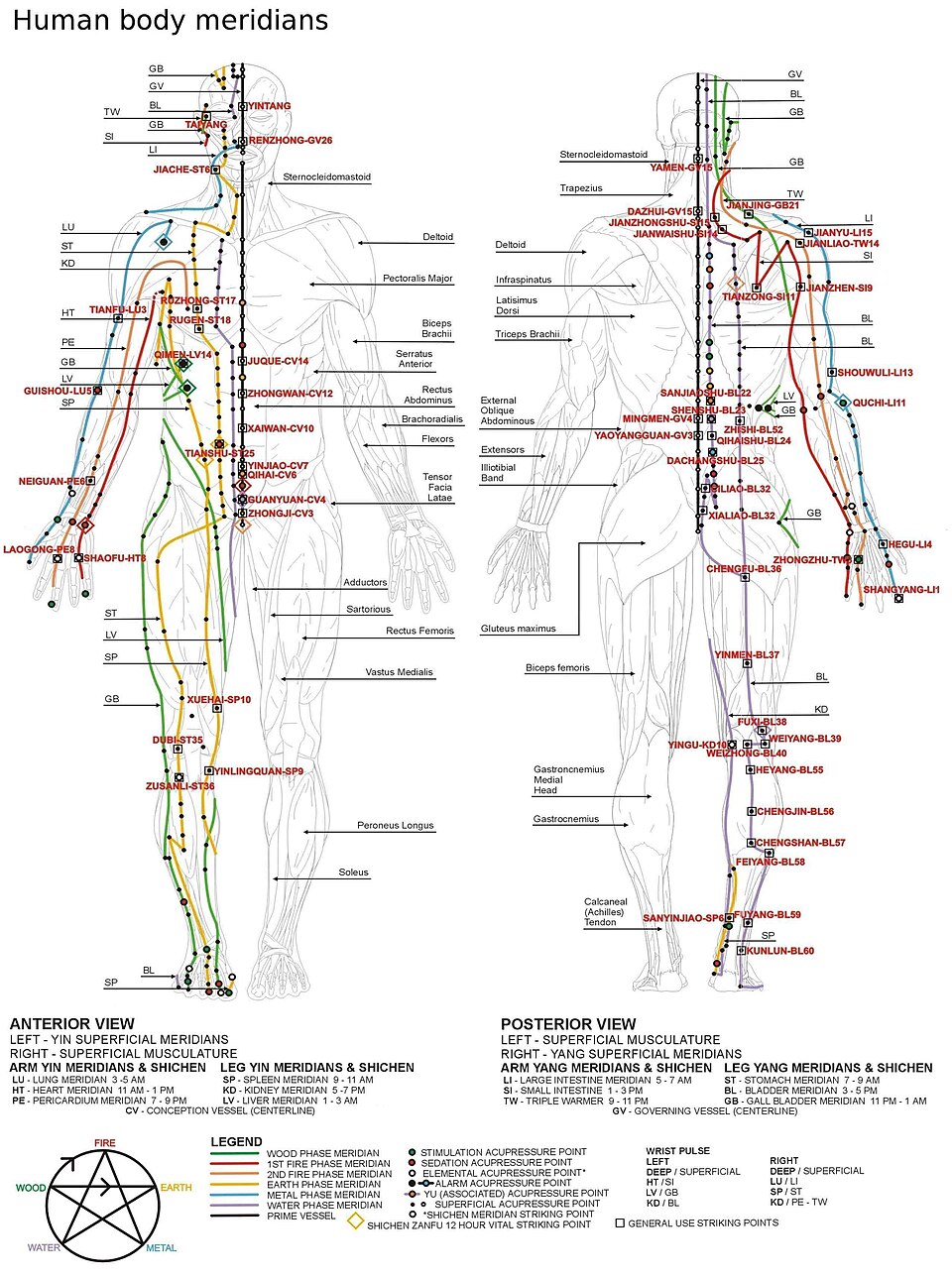
The meridian system (jingluo, 经络) as codified in the Huangdi Neijing consists of twelve primary meridians (jingmai), each associated with a major organ and forming a continuous network through which qi and blood circulate in a defined sequence over a twenty-four-hour cycle. Six of the meridians are classified as yin and traverse the inner, ventral aspects of the limbs and trunk, while six are classified as yang and traverse the outer, dorsal aspects. Each yin meridian is paired with a yang meridian, forming six yin-yang pairs that correspond to the six pairs of coupled zang-fu organs: lung-large intestine, spleen-stomach, heart-small intestine, kidney-bladder, pericardium-triple burner, and liver-gallbladder. The meridians are connected at their extremities, creating a closed circuit through which qi circulates in a prescribed order, beginning with the lung meridian in the early morning hours and completing a full cycle every twenty-four hours. This chronobiological dimension of meridian theory — the association of each meridian with a specific two-hour period of maximal activity — provided the theoretical basis for the practice of selecting treatment times according to the body's internal clock, a concept that finds echoes in modern chronotherapeutics (Unschuld, 2003, pp. 168–185).
In addition to the twelve primary meridians, the classical system includes eight extraordinary meridians (qijing bamai) that serve as reservoirs of qi and blood, regulating the distribution of vital substances when the primary system is overwhelmed. The most important of these are the Ren Mai (Conception Vessel), which runs along the anterior midline of the body, and the Du Mai (Governing Vessel), which runs along the posterior midline, together forming the "small heavenly circuit" (xiao zhoutian) that is central to Daoist meditation and internal alchemy practices. Fifteen luo (connecting) meridians link the yin-yang pairs, while twelve divergent meridians, twelve muscle regions, and twelve cutaneous regions extend the network to encompass the entire body surface and musculoskeletal system. The total system, as mapped in the classical texts, describes a comprehensive circulatory network that connects every part of the body to every other part, providing a theoretical basis for the clinical observation that pathology in one area can produce symptoms in seemingly unrelated locations (Needham & Lu, 2000, pp. 95–120).
Modern anatomical and physiological research has attempted to identify the physical substrate of the meridians with mixed results. Studies using radioactive tracers, thermography, and electrical impedance measurements have reported that some acupuncture points and meridian pathways exhibit measurable physical characteristics — lower electrical resistance, higher density of nerve endings, or proximity to intermuscular fascial planes — but these findings have been inconsistent across studies and have not yielded a consensus model of meridian anatomy. More recently, researchers have proposed that the meridian network may correspond to fascial planes, interstitial fluid channels, or networks of peripheral nerve fibers, but none of these hypotheses has achieved definitive confirmation. As Sivin (1987) observed, the question of whether the meridians represent discrete anatomical structures or functional relationships that emerge from the interaction of multiple physiological systems remains one of the most fascinating open questions at the intersection of traditional Chinese medicine and modern biomedical science.
Acupoints and the Art of Point Selection
The classical acupuncture system recognizes 361 acupoints (xuewei, 穴位) distributed along the twelve primary meridians and the two midline extraordinary meridians. Each acupoint has a Chinese name — often evocative and poetic, such as Hegu (合谷, "Joining Valley," located on the hand), Zusanli (足三里, "Leg Three Miles," located below the knee), or Baihui (百会, "Hundred Meetings," located at the crown of the head) — as well as an alphanumeric designation based on the meridian to which it belongs and its sequential position along that meridian. The World Health Organization standardized the nomenclature and location of these 361 points in 1991, providing a common reference framework that facilitated international research and clinical communication. Beyond the standard 361 points, Chinese medical tradition recognizes numerous "extra points" (jingwai qixue) that do not lie on the regular meridians but have demonstrated clinical utility, as well as the "ashi" (tender) points described by Sun Simiao in the seventh century, which are selected based on the location of pain or sensitivity rather than a fixed anatomical position (Unschuld, 2003, pp. 190–210).
The art of point selection — determining which acupoints to needle for a given condition — is one of the most intellectually demanding aspects of acupuncture practice. Classical principles of point selection include local treatment (selecting points near the site of pathology), distal treatment (selecting points on the same meridian but far from the site of symptoms), contralateral treatment (needling the opposite side of the body), and points selected according to five-phase relationships among the organ systems. The Lingshu describes the "five shu points" — a system of five specific points on each meridian below the elbow or knee, each corresponding to one of the five phases and having a specific therapeutic function — that forms the basis of one of the most sophisticated point selection strategies in acupuncture. The clinical reasoning involved in point selection requires the practitioner to integrate diagnostic information about the patient's condition with knowledge of meridian pathways, point functions, and the physiological relationships among the organ systems, producing a treatment plan that is both theoretically grounded and individually tailored (Sivin, 1987, pp. 170–195).
Needling technique is itself a refined art that encompasses not only the depth and angle of insertion but also the manipulation of the needle after insertion to produce specific physiological effects. The Neijing distinguishes between tonifying (bu) and reducing (xie) techniques: tonifying methods, which strengthen deficient functions, typically involve gentle insertion with slow, clockwise rotation, while reducing methods, which disperse excess, involve more vigorous insertion with rapid, counterclockwise rotation. The arrival of qi (deqi, 得气) — a characteristic sensation of heaviness, distension, or tingling that indicates the needle has engaged the body's qi — is considered essential for therapeutic efficacy in traditional practice. Modern research has associated the deqi sensation with the stimulation of specific nerve fiber types and the release of endorphins and other neurotransmitters, providing a partial neurophysiological explanation for a phenomenon that has been described in Chinese medical texts for over two thousand years (Harper, 1998, pp. 95–108).
"Better to miss the acupoint than to miss the meridian."
Traditional acupuncture proverbThe Bronze Acupuncture Models
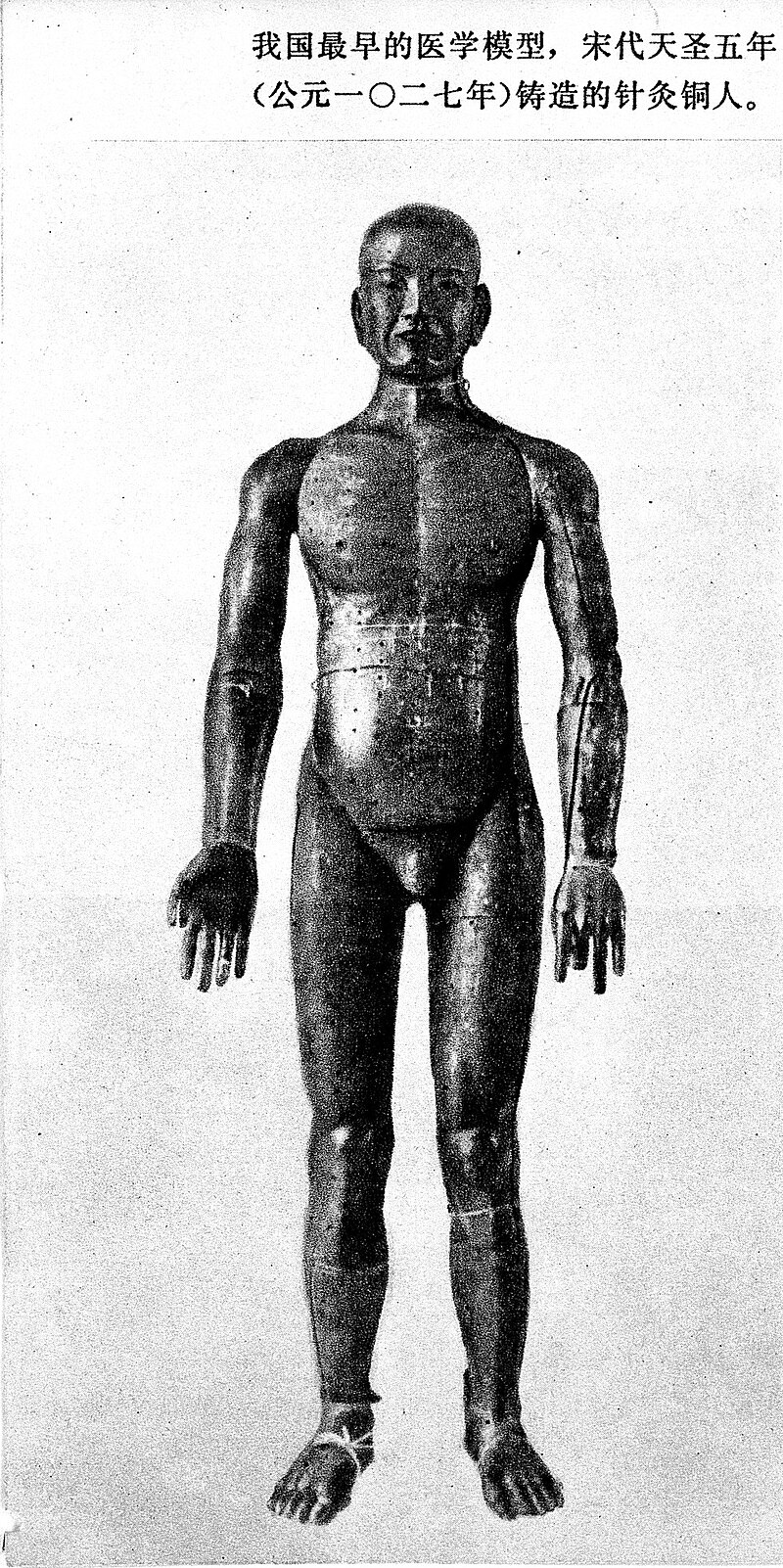
One of the most remarkable artifacts in the history of Chinese medicine is the bronze acupuncture figure (tongren, 铜人) commissioned by the Song dynasty physician Wang Weiyi in 1027 CE. Wang Weiyi, serving as imperial medical officer under Emperor Renzong, created two life-sized hollow bronze figures with precisely marked acupoint locations, accompanied by a comprehensive text, the Tongren Shuxue Zhenjiu Tujing (Illustrated Manual of Acupoints on the Bronze Figure for Acupuncture and Moxibustion). These bronze figures served both as teaching tools and as examination instruments: the figures were covered with wax and filled with water, and students were required to insert needles at the correct acupoint locations — if the needle was correctly placed, water would flow from the puncture, providing an objective test of the student's anatomical knowledge. This ingenious examination method, which combined three-dimensional anatomical modeling with practical assessment, had no parallel in Western medical education for centuries (Needham & Lu, 2000, pp. 130–148).
The creation of the bronze acupuncture figures reflected the Song dynasty's broader commitment to standardizing and institutionalizing medical education. Emperor Renzong's court was deeply invested in medical reform, establishing the Imperial Medical Academy (Taiyi Yuan) as a degree-granting institution with separate departments for internal medicine, surgery, acupuncture, and other specialties. The bronze figures addressed a practical problem that had long plagued acupuncture education: the difficulty of precisely locating acupoints from textual descriptions alone, even when accompanied by two-dimensional illustrations. By providing three-dimensional models with clearly marked point locations, Wang Weiyi created a standardized reference that reduced the variability in point location that inevitably arose when practitioners relied solely on written instructions and anatomical landmarks. The accompanying text carefully specified the depth of insertion and the angle of the needle for each point, further standardizing clinical practice. As Unschuld (2003) noted, the bronze figure project represented a characteristically Song dynasty approach to knowledge: systematic, institutionally supported, and oriented toward the creation of authoritative standards that could be uniformly applied across the empire.
The original Song dynasty bronze figures have been lost, but several later replicas survive in museums in China and Japan, and modern reproductions continue to be used in acupuncture education worldwide. The concept of the anatomical teaching model, pioneered by Wang Weiyi nine centuries ago, remains central to acupuncture training, though contemporary models incorporate modern materials and digital technology. Recent archaeological discoveries have also shed new light on the pre-Song history of acupuncture models: a lacquered wooden figure with inscribed meridian lines, dating to the Western Han dynasty and excavated from a tomb in Sichuan province in 1993, demonstrates that three-dimensional acupuncture models existed at least a thousand years before Wang Weiyi's celebrated bronze figures. These discoveries suggest that the practice of using physical models to teach acupoint location and meridian pathways may be as old as acupuncture itself, reflecting the fundamentally embodied nature of a medical art that depends on precise manual skill and intimate knowledge of the body's three-dimensional geography (Lo, 2001, pp. 50–68).
Modern Research and Global Recognition
The scientific investigation of acupuncture has intensified dramatically since the 1970s, when President Nixon's visit to China and the widely publicized account of journalist James Reston's post-surgical acupuncture analgesia in Beijing brought Chinese medical practices to international attention. Subsequent decades have seen thousands of clinical trials, systematic reviews, and mechanistic studies investigating acupuncture's efficacy and physiological basis. The current scientific consensus, as reflected in major reviews by the Cochrane Collaboration and national health technology assessment agencies, is that acupuncture demonstrates credible evidence of efficacy for a limited range of conditions — particularly chronic pain conditions such as low back pain, osteoarthritis of the knee, tension-type headache, and migraine — while evidence for many other traditional indications remains inconclusive or insufficient. The most significant mechanistic insight has been the demonstration that acupuncture stimulation triggers the release of endogenous opioids, including endorphins, enkephalins, and dynorphins, providing a neurochemical explanation for acupuncture's well-documented analgesic effects (Unschuld, 2003, pp. 330–348).
The World Health Organization has played an important role in promoting the standardization and global integration of acupuncture. The WHO's 1991 standardization of acupoint nomenclature and location provided an essential common reference framework for international research and clinical practice. In 2003, the WHO published a review identifying over forty conditions for which acupuncture had demonstrated therapeutic benefit in controlled trials, and in 2019, the inclusion of traditional Chinese medical diagnostic categories in the International Classification of Diseases (ICD-11) further institutionalized acupuncture within the global health framework. Acupuncture is now practiced in over 180 countries, is regulated as a licensed health profession in most Western nations, and is covered by public health insurance systems in Germany, Switzerland, and several other European countries. The integration of acupuncture into mainstream health care systems has been accompanied by the development of standardized training programs, professional licensing examinations, and evidence-based clinical guidelines that seek to combine traditional knowledge with modern standards of safety and efficacy (Sivin, 1987, pp. 200–220).
Despite its growing global acceptance, acupuncture remains a subject of vigorous scientific debate. Critics argue that the evidence base is weakened by methodological challenges — particularly the difficulty of designing adequate placebo controls for a physically invasive procedure — and that much of acupuncture's apparent efficacy may be attributable to non-specific effects such as expectation, therapeutic context, and the practitioner-patient relationship. Supporters counter that the consistent demonstration of specific neurophysiological effects, the reproducibility of acupuncture's analgesic mechanisms across species (including in animals not subject to placebo effects), and the growing evidence from neuroimaging studies all support a genuine physiological mechanism of action. What is beyond dispute is that acupuncture, born from the empirical observations of ancient Chinese healers and refined through two millennia of continuous clinical practice, has become one of the most widely adopted therapeutic modalities in the world — a remarkable achievement for a tradition rooted in the concept of invisible meridians and the intangible substance of qi (Lo, 2001, pp. 100–125).
Quiz
What was the primary role of the bronze acupuncture figures created by Wang Weiyi?
Which meridian pair is associated with the kidney and bladder?
What discovery added an intriguing dimension to the debate about the origins of acupuncture?
What is the traditional sensation indicating the needle has engaged the body's qi?
What is the primary purpose of moxibustion in acupuncture practice?
Which country played a role in the development of auricular acupuncture?
How has the World Health Organization contributed to the global integration of acupuncture?
What is a major challenge in acupuncture research according to critics?
Write your thoughts, then get feedback from Jason — you can turn any answer into a full discussion.
9. Why do you think acupuncture has maintained its popularity and relevance across different cultures and eras?
10. How might the historical development of acupuncture influence its perception and use in modern healthcare settings?
Frequently Asked Questions
Common questions about Acupuncture: Mapping the Body's Meridian Network
How does acupuncture work according to Chinese medicine?
According to traditional Chinese medicine, acupuncture works by inserting fine needles into specific points along the body's meridian network to regulate the flow of qi (vital energy). Stimulating these points is believed to remove blockages, restore balance between yin and yang, and activate the body's natural healing responses.
What are meridians in Chinese medicine?
Meridians are a network of invisible channels through which qi and blood flow throughout the body, connecting the surface to internal organs. The standard system comprises twelve primary meridians corresponding to major organ systems, plus eight extraordinary vessels that serve as reservoirs of qi and regulate the primary channels.
How many acupuncture points are there in the human body?
The classical acupuncture system identifies approximately 365 standard points along the twelve primary meridians and the governing and conception vessels. Over the centuries, additional extra points and microsystem points (such as ear acupuncture points) have been documented, bringing the total to well over 400 recognized treatment locations.
What is the history of acupuncture needles?
The earliest acupuncture tools were sharp stones called bian shi, used during the Neolithic period to stimulate or lance body surfaces. Over time, these evolved into bone and bamboo needles, then bronze and iron needles during the Zhou and Han dynasties, and finally the fine stainless steel filiform needles used in modern clinical practice.
Is there scientific evidence that acupuncture is effective?
Modern research has found evidence supporting acupuncture's effectiveness for conditions including chronic pain, nausea, and migraine headaches, with neuroimaging studies showing measurable effects on brain activity and pain pathways. The World Health Organization recognizes acupuncture as a viable treatment for dozens of conditions, though debate continues about the mechanisms behind its effects.