
Podcast


Podcast: The Tang Dynasty: A Golden Age of Poetry and Power
Listen to Jason & Amy discuss The Tang Dynasty: A Golden Age of Poetry and Power
New here?
The Rise of a Superpower
The Tang dynasty emerged from the wreckage of the short-lived Sui dynasty, which had reunified China after centuries of division but exhausted itself through overambitious construction projects and disastrous military campaigns against Korea. In 617, Li Yuan, a frontier general of mixed Chinese and Turkic ancestry, marched on the Sui capital and seized the throne with the help of his brilliant and ruthless second son, Li Shimin. Within a decade, Li Shimin had eliminated his brothers — one murdered at the palace gate in the Xuanwu Gate Incident of 626 — and ascended the throne himself as Emperor Taizong (太宗), one of the most capable rulers in Chinese history.
Taizong's reign (626–649) established the political and institutional foundations on which the Tang would flourish for nearly three centuries. He refined the civil service examination system, opening government office to men of talent regardless of aristocratic birth. He organized the empire into a hierarchical system of provinces, prefectures, and counties administered by centrally appointed officials. He maintained a powerful military that projected Tang influence deep into Central Asia, establishing protectorates over the oasis kingdoms of the Silk Road and receiving the submission of Turkic and Tibetan chieftains. At its height under Taizong and his successors, the Tang empire stretched from the Korean peninsula to the borders of Persia, encompassing a territory and population that made it arguably the most powerful state on earth.
But Taizong's greatest legacy may have been cultural rather than political. He was himself a calligrapher, poet, and patron of learning who gathered the finest scholars of his age at court. He established the Imperial Academy (国子监, Guózǐ Jiàn) as the premier institution of higher learning in the empire and commissioned the compilation of official histories, encyclopedias, and literary anthologies. He set the tone for a dynasty that would prize literary achievement as the highest mark of civilization — a dynasty in which the ability to compose elegant verse was not merely an accomplishment but a qualification for governing the state.
Chang'an: Crossroads of the World
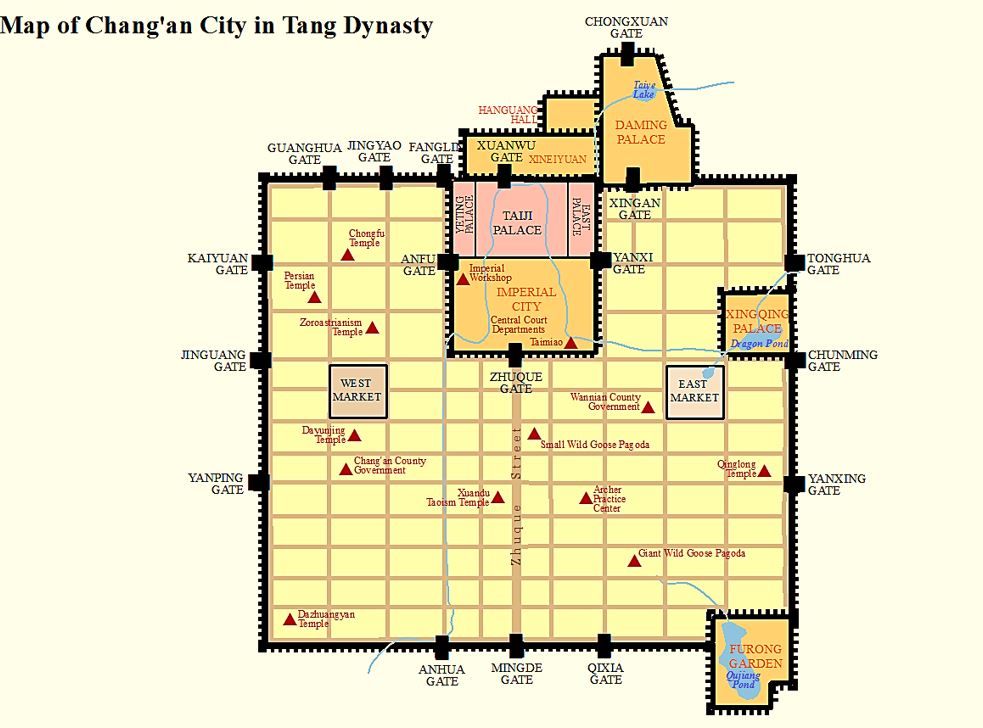
The Tang capital of Chang'an (长安, modern Xi'an) was the largest and most cosmopolitan city on earth, home to perhaps two million people within its walls and surrounding districts. Its grid of broad avenues, laid out with geometric precision, enclosed an area of more than eighty square kilometers — larger than contemporary Constantinople and many times the size of any European city. The palace complex alone occupied an area comparable to a small town. Two great markets, the East Market and the West Market, served as the commercial engines of the city: the East Market catered primarily to the Chinese elite, while the West Market was the domain of foreign traders — Sogdians, Persians, Arabs, Turks, Indians, Koreans, and Japanese — who brought their goods, their languages, their religions, and their cuisines into the heart of the Chinese empire.
Chang'an's cosmopolitanism was not merely tolerated but celebrated. Tang aristocrats wore Central Asian fashions, played polo (a sport imported from Persia), drank grape wine from western lands, and listened to the music of Central Asian lutes and drums. The court maintained diplomatic relations with the Byzantine Empire, the Abbasid Caliphate, and the kingdoms of India and Southeast Asia. Foreign religions flourished: Buddhist monasteries, Daoist temples, Zoroastrian fire temples, Nestorian Christian churches, Manichaean halls, and eventually mosques all stood within the city walls. The Tang census recorded residents from more than three hundred foreign kingdoms and territories living in the capital.
This openness to the outside world was inseparable from Tang self-confidence. The Tang Chinese did not embrace foreign cultures out of insecurity but from a position of supreme power. They were the center of the civilized world, and their willingness to absorb foreign influences was itself a demonstration of cultural supremacy — a declaration that Chinese civilization was capacious enough to encompass everything the world had to offer. This attitude produced one of the most creative periods in Chinese history, as native traditions of poetry, painting, and philosophy were enriched and transformed by contact with the vast world beyond China's borders.
The Poetry Revolution
The Tang dynasty produced more great poetry than any comparable period in any civilization. The Complete Tang Poems (全唐诗, Quán Táng Shī), compiled in 1705, contains nearly 49,000 poems by over 2,200 identified poets — and these represent only a fraction of the verses actually composed during the dynasty's three centuries. Poetry was not a specialized art practiced by a literary elite; it was woven into the fabric of daily life. Officials composed poems at farewell banquets and promotion ceremonies. Monks wrote verse on monastery walls. Courtesans were valued as much for their poetic skill as for their beauty. The civil service examination, the gateway to political power, required candidates to compose poetry under timed conditions — making literary talent, quite literally, a prerequisite for governing the empire.
The Tang poets perfected the regulated verse forms — lüshi (律诗) and jueju (绝句) — that would dominate Chinese poetry for the next millennium. These forms imposed strict rules of tone, rhyme, and parallelism that elevated composition to an exercise in disciplined artistry comparable to the sonnet in the Western tradition. A lüshi consists of eight lines of five or seven characters each, with prescribed tonal patterns and mandatory parallel couplets. Within these constraints, the finest poets achieved effects of extraordinary compression and emotional power — entire landscapes of feeling evoked in forty or fifty-six characters.
But the Tang poets also wrote in freer forms — ancient-style verse (古体诗, gǔtǐ shī), songs and ballads (歌行, gēxíng), and folk-influenced lyrics (乐府, yuèfǔ) — that allowed for longer narratives, social commentary, and wildly imaginative flights of fancy. The range of Tang poetry is staggering: it encompasses drinking songs and Buddhist meditations, battlefield laments and love letters, political satire and philosophical inquiry, nature descriptions of crystalline precision and mythological journeys to the heavens. No human emotion, no landscape, no social situation was considered unworthy of poetic treatment. The Tang poets democratized the art of verse and elevated it to the supreme expression of Chinese literary culture.
Discuss with Jason
Want to talk this article through?
Jason discusses the article with you, quizzes you on it and teaches you words from it.
Sign in free to ask. New accounts start with 300 AI credits.
Li Bai and Du Fu
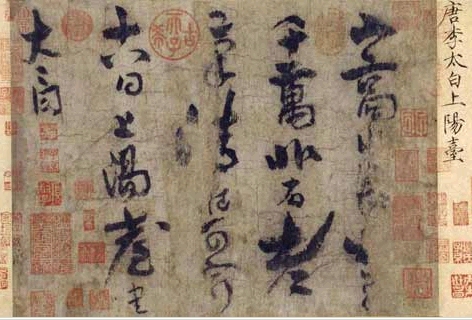
The two supreme figures of Tang poetry — and arguably of all Chinese literature — are Li Bai (李白, 701–762) and Du Fu (杜甫, 712–770), whose contrasting genius embodies the full range of the poetic art. Li Bai, known as the "Immortal of Poetry" (诗仙, Shīxiān), was a Daoist romantic who wrote with effortless spontaneity about wine, moonlight, friendship, and the longing for transcendence. His verse has the quality of improvisation — as if the words arrived fully formed, without labor or revision. He drank prodigiously, boasted extravagantly, and wandered the empire seeking patrons, adventures, and the company of kindred spirits. Legend holds that he drowned while drunkenly trying to embrace the moon's reflection in a river — a death that, if apocryphal, is perfectly in character.
Du Fu, by contrast, is honored as the "Sage of Poetry" (诗圣, Shīshèng), a title that reflects his moral gravity, his technical mastery, and his profound engagement with the suffering of ordinary people. Where Li Bai soars, Du Fu witnesses. His greatest poems were written during and after the An Lushan Rebellion (755–763), a catastrophic civil war that devastated the Tang empire, killed millions, and drove Du Fu into years of poverty and wandering. Poems like "Spring View" (春望), written as he gazed at the ruined capital, and "Ballad of the Army Carts" (兵车行), which records the grief of conscripted soldiers and their families, achieve a moral authority that Chinese readers have revered for twelve centuries.
The friendship between Li Bai and Du Fu — they met in 744 and traveled together briefly — is one of the great literary relationships in world culture, though it was apparently closer on Du Fu's side than on Li Bai's. Du Fu wrote a dozen poems to or about Li Bai, expressing admiration, worry, and longing. Li Bai left only two poems addressed to Du Fu. The asymmetry has fascinated Chinese scholars for centuries. Together, they represent the twin poles of Chinese poetic sensibility: the ecstatic and the compassionate, the transcendent and the grounded, the wine cup and the tear.
"Bright moonlight before my bed — could it be frost upon the ground? I raise my head to gaze at the moon, then lower it, thinking of home."
Li Bai (李白), "Quiet Night Thought" (静夜思)Arts, Technology, and Culture
The Tang dynasty's achievements extended far beyond poetry. In painting, the Tang era saw the emergence of landscape art as a major genre and the refinement of figure painting to new levels of sophistication. Wu Daozi (吴道子), the greatest painter of the age, was said to work with such inspired fury that crowds gathered to watch him paint. His murals in Buddhist temples — now lost, known only through copies and descriptions — were reputed to possess an almost supernatural vitality, with figures that seemed to breathe and move. The tradition of court painting flourished under imperial patronage, producing portraits, historical scenes, and images of court life that remain foundational documents of Chinese art history.
Tang ceramics achieved a technical and aesthetic standard that would influence pottery production across East Asia for centuries. The sancai (三彩, "three-color") glazed earthenware — typically combining amber, green, and cream in flowing, marbled patterns — is among the most recognizable artifacts of the dynasty. Produced primarily as burial goods for the tombs of the wealthy, sancai figures depict an extraordinary range of subjects: prancing horses, seated camels, robed officials, foreign merchants with bulging eyes and curly beards, and court ladies in elaborate hairstyles. These ceramics provide an invaluable visual record of Tang daily life and of the Central Asian influences that permeated it.
The Tang period also witnessed major technological advances. Block printing, first developed during the Tang, revolutionized the dissemination of knowledge. The oldest known dated printed text — a copy of the Diamond Sutra (金刚经, Jīngāng Jīng) from 868 CE, discovered in the Dunhuang cave library — is a Tang dynasty product of remarkable sophistication. Gunpowder, though its military applications would not be fully developed until later dynasties, was first described in Tang alchemical texts. The Tang also saw advances in medicine, astronomy, cartography, and clockwork engineering, including the elaborate water-driven astronomical clock tower designed by the monk Yi Xing in the early eighth century.
The An Lushan Catastrophe
The golden age of the Tang effectively ended with the An Lushan Rebellion (安史之乱, Ān Shǐ zhī Luàn), one of the most destructive conflicts in human history. In 755, An Lushan (安禄山), a general of Sogdian and Turkic descent who commanded a massive frontier army in the northeast, launched a rebellion against the central government. An Lushan had been a favorite of Emperor Xuanzong (玄宗) and, according to court gossip, a lover of the emperor's consort, Yang Guifei (杨贵妃). His revolt exposed the fundamental weakness of the late Tang military system: the empire had placed enormous armies under the command of frontier generals while allowing the central forces to atrophy. When An Lushan's troops marched south, there was little to stop them.
The rebel forces captured the eastern capital of Luoyang and then the western capital of Chang'an itself. Emperor Xuanzong fled southwest toward Sichuan with his court and guards. At the Mawei postal station, the imperial guard mutinied, killing the chief minister Yang Guozhong and demanding the death of Yang Guifei, whom they blamed for the disaster. The emperor, surrounded by armed soldiers, had no choice but to order her execution. The scene — the aged emperor weeping as his beloved consort is strangled with a silk cord beside the road — became one of the most painted, poeticized, and dramatized episodes in Chinese cultural history, the subject of Bai Juyi's narrative masterpiece "Song of Everlasting Sorrow" (长恨歌, Cháng Hèn Gē).
The rebellion was eventually suppressed in 763, but only with the help of Uyghur and Tibetan allied forces whose assistance came at a steep price. The Tang empire that emerged from the war was fundamentally diminished. Central authority had been shattered; regional military governors (节度使, jiédùshǐ) ruled their territories as virtual independent kingdoms. The population of the empire, estimated at around 53 million before the rebellion, may have declined by as many as 36 million through a combination of massacre, famine, displacement, and disease — a demographic catastrophe on a scale that would not be matched in China until the Taiping Rebellion of the nineteenth century.
"The nation is broken, though hills and rivers remain; in the city, spring — grass and trees grow thick."
Du Fu (杜甫), "Spring View" (春望)The Eternal Standard
The Tang dynasty limped on for another century and a half after the An Lushan Rebellion, producing flashes of brilliance — the late Tang poets Li Shangyin and Du Mu, the prose stylists Han Yu and Liu Zongyuan — but never recovering its former power. Regional warlords gradually devoured the empire's substance. The final Tang emperor abdicated in 907, and China fragmented once again into a patchwork of competing kingdoms known as the Five Dynasties and Ten Kingdoms period.
But the Tang left an indelible mark on Chinese civilization — and on the civilizations it had influenced. In Japan, the Tang model shaped everything from governmental structure to city planning to the writing system. The Japanese capital of Nara was modeled on Chang'an; Japanese kanji are Chinese characters as they were transmitted during the Tang. In Korea, Vietnam, and across Southeast Asia, Tang culture set standards of literary, artistic, and administrative achievement that endured for centuries. The very word for "Chinatown" in many Southeast Asian languages derives from the Tang: in Malay and Thai, Chinese people are still called "Tang people" (唐人, Tángrén), and Chinatowns are "Tang People Streets" (唐人街, Tángrén Jiē).
Within China, the Tang became the gold standard of civilization. When later dynasties looked back to a model of cultural achievement, political cosmopolitanism, and literary glory, they looked to the Tang. The Tang poets remained — and remain — the supreme exemplars of the art. Tang dynasty verses are memorized by every Chinese schoolchild; they are quoted in speeches, inscribed on buildings, and woven into daily conversation. The Tang represents, in the Chinese cultural imagination, the moment when poetry, power, and openness to the world converged to produce something approaching perfection. That the perfection was brief — shattered by war, corruption, and the entropy that devours all empires — only deepens its hold on the imagination. The Tang is remembered not despite its fall but because of it: as a reminder that golden ages are real, and that they end.
"In heaven, let us be birds flying side by side; on earth, let us be branches intertwined."
Bai Juyi (白居易), "Song of Everlasting Sorrow" (长恨歌)Quiz
Who was the founder of the Tang dynasty?
What was Emperor Taizong's contribution to the Tang dynasty's governance?
Which city served as the capital of the Tang dynasty?
What is the significance of the Complete Tang Poems?
How did the Tang dynasty view foreign cultures?
What was Li Bai known for in Tang poetry?
What technological advancement is associated with the Tang dynasty?
What event marked the decline of the Tang dynasty's golden age?
Write your thoughts, then get feedback from Jason — you can turn any answer into a full discussion.
9. Why do you think the Tang dynasty is considered a 'golden age' in Chinese history?
10. How might the Tang dynasty's openness to foreign cultures be relevant to today's global society?
Frequently Asked Questions
Common questions about The Tang Dynasty: A Golden Age of Poetry and Power
Why is the Tang dynasty considered the golden age of China?
The Tang dynasty (618-907 CE) is considered China's golden age because it achieved an extraordinary combination of military power, cultural brilliance, and cosmopolitan openness. Its capital Chang'an was the largest and most diverse city in the world, the empire stretched from Korea to Central Asia, and it produced some of the greatest poetry, art, and scholarship in Chinese history. The civil service examination system also matured during this period.
Who were the most famous Tang dynasty poets?
The most celebrated Tang dynasty poets are Li Bai (李白) and Du Fu (杜甫), often considered the two greatest poets in all of Chinese literature. Li Bai was known for his romantic, spontaneous verse celebrating wine, moonlight, and freedom, while Du Fu wrote deeply compassionate poetry about war, suffering, and social injustice. Together with Wang Wei and Bai Juyi, they defined Chinese poetry for all subsequent generations.
What made Chang'an the greatest city in the Tang dynasty?
Tang dynasty Chang'an (modern Xi'an) was the largest city in the world, home to roughly one million residents within its walls and another million in the surrounding suburbs. It was laid out on a grand grid pattern covering 84 square kilometers and hosted communities of Persians, Arabs, Turks, Koreans, Japanese, and Indians. Its Western Market was the commercial hub of the entire Silk Road trading network.
What was the An Lushan Rebellion and how did it affect the Tang dynasty?
The An Lushan Rebellion (755-763 CE) was a devastating civil war led by a Sogdian-Turkic general named An Lushan against the Tang court. It killed an estimated 36 million people, making it one of the deadliest conflicts in human history. Although the Tang dynasty survived, it never fully recovered its former power. The rebellion marked the beginning of a long decline that ended with the dynasty's fall in 907 CE.
How did the Tang dynasty examination system work?
The Tang examination system tested candidates on their knowledge of Confucian classics, history, law, and their ability to compose poetry and prose. Passing the highest-level exam (进士, jìnshì) was extraordinarily difficult, with success rates often below two percent. However, success could elevate a commoner to the highest ranks of government, establishing the principle that talent and learning, not birth, should determine who governs.